Before this dialogue, my enquiry focused on what happens when a designer gives up direct control over visual composition. Through projects such as Graphic Maze, I had been testing whether participants’ movements and decisions could generate graphic form. Later experiments developed this further: one participant’s trace could become material for the next person, suggesting that authorship might move away from a finished image and towards the design of rules, interfaces and conditions for participation. The conversation helped me recognise that this was not only a question of interaction. It was becoming a question of relationality: how meaning is produced between people through a designed system.
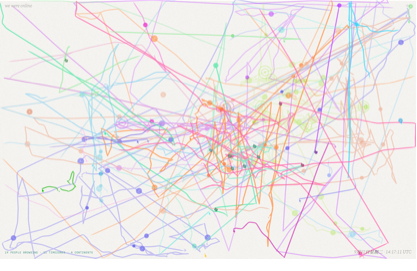
reference introduced during the dialogue made this shift especially clear. Morris introduced Spencer Chang’s browser-based artwork we were online, a browser extension that turns ordinary web browsing into a shared experience. On Wikipedia, users can see other visitors on the same article, follow their cursors through linked pages and continue into shared informational ‘rabbit holes’. The project also collects cursor trails, clicks, scrolling and navigation rhythms as visual ‘internet portraits’ (Chang, 2026). A movement through information therefore becomes both a graphic trace and a route another person can enter. This example expanded my understanding of participation. Rather than asking only how an individual can affect a visual outcome, I can now ask how one participant’s actions establish the conditions for another’s. The resulting graphic is no longer simply a record of input; it can function as an invitation, constraint or point of departure.
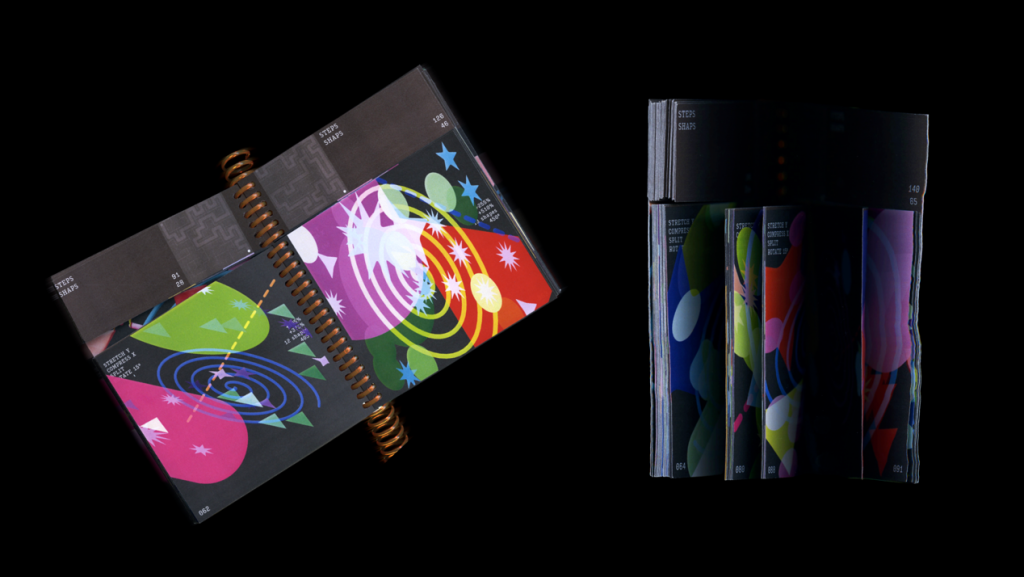
The dialogue also made me reconsider a recurring feature of my practice: digital interactions often return to physical form. I have translated interactive processes into publications or allowed audience activity to become drawing. Morris responded positively to this tendency but asked why I make this transition and what it changes for the audience. This question revealed that moving from screen to paper should not be treated as a neutral method of presentation. When a temporary digital action becomes a printed or material trace, it acquires duration, visibility and a different kind of ownership. At the same time, the designer regains control by selecting, editing and arranging what is preserved. The physical outcome can therefore expose a tension within my enquiry: I may relinquish control while an interaction unfolds, yet reclaim authorship when I frame its results.
Morris’s own project Sandbox makes this physical-digital relationship more concrete. The project brought together a physical and digital exhibition, participatory workshops, public events and an evolving resource archive. Rather than separating online and offline experience, Morris describes both as forms of human interaction and maintains a cyclical connection between them (Taker, 2025). This suggests that translating an experience into another medium does not have to produce a final, fixed object. It can expand the routes through which people enter a project, contribute to it and encounter one another. For my practice, the question therefore becomes not simply how a digital interaction can be materialised, but what new relationships become possible through that translation and which audiences each form enables or excludes.
This changes how I understand the designer’s role. The designer does not truly disappear or surrender authorship; the role shifts from manufacturing every graphic form to organising relations, rules and possibilities. This feels particularly relevant in the context of artificial intelligence and vibe coding. These tools can accelerate production, but design has never been valuable only because it is fast. Its value also lies in connecting contexts, constructing narratives, communicating emotion and creating situations in which different positions can meet or collide. Morris’s emphasis on community, education and criticality, rather than technological perfection, reinforces this position. Her use of accessible tools and intentionally imperfect aesthetics prioritises the story and the conditions for participation over technical mastery (Taker, 2025). As execution becomes easier, the critical design decisions become more visible: who is able to participate, what the system records, how one action affects another, what is excluded, and how the resulting traces are interpreted.
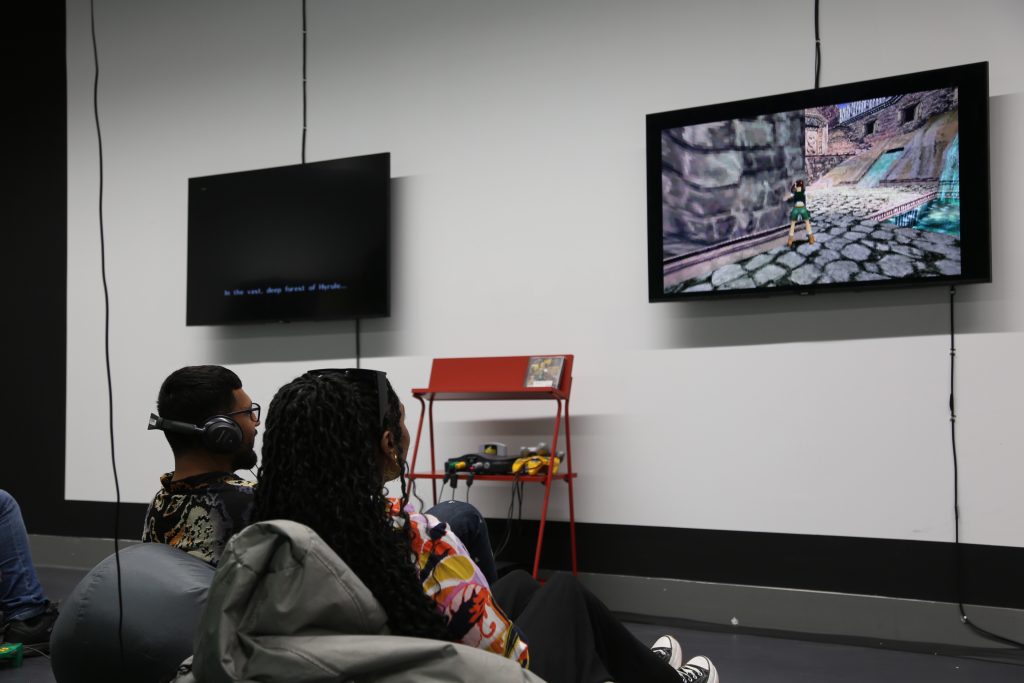
The recommendation to study FACT Liverpool further situated this enquiry within digital art and game culture. Institutions, technologies, technicians and modes of display all influence whether an interactive work can be encountered as art. This adds another layer to the network: meaning is not produced only by the designer and participants, but also by the interface, device, exhibition context and methods of documentation. These are not passive containers; they help determine what kinds of participation are possible and whose actions become visible.
The dialogue did not provide a final answer to my enquiry. More importantly, it changed what I understood the enquiry to be. I am no longer asking only whether participants can generate graphics when the designer steps back. I am asking how a designer can construct a system in which participants generate meaning through one another’s traces, and how digital and physical forms frame that relationship differently. My next stage of practice will therefore continue through relational experiments and conversations with participants. Their responses will help me examine whether they experience another person’s trace as collaboration, restriction, authorship or something else. In this way, dialogue becomes more than commentary on the work: it becomes part of the method through which the work and its questions continue to develop.
References
Chang, S. (2026) ‘we were online’. Available at: https://wewere.online/ (Accessed: 22 September 2026).
Morris, J. (2026) Personal communication with the author, 22 September.
Taker, L. (2025) ‘Slow Play, Shared Futures: an interview with Jazmin Morris about Sandbox’, Corridor8, 1 September. Available at: https://corridor8.co.uk/article/slow-play-shared-futures-an-interview-with-jazmin-morris-about-sandbox/ (Accessed: 22 September 2026).
Leave a Reply