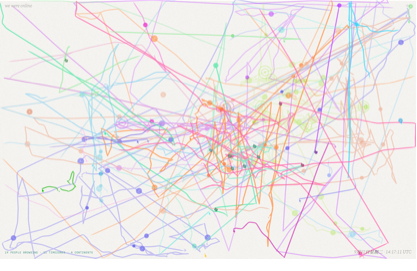
Before this dialogue, my enquiry focused on what happens when a designer gives up direct control over visual composition. Through projects such as Graphic Maze, I had been testing whether participants’ movements and decisions could generate graphic form. Later experiments developed this further: one participant’s trace could become material for the next person, suggesting that authorship might move away from a finished image and towards the design of rules, interfaces and conditions for participation. The conversation helped me recognise that this was not only a question of interaction. It was becoming a question of relationality: how meaning is produced between people through a designed system.
reference introduced during the dialogue made this shift especially clear. Morris introduced Spencer Chang’s browser-based artwork we were online, a browser extension that turns ordinary web browsing into a shared experience. On Wikipedia, users can see other visitors on the same article, follow their cursors through linked pages and continue into shared informational ‘rabbit holes’. The project also collects cursor trails, clicks, scrolling and navigation rhythms as visual ‘internet portraits’ (Chang, 2026). A movement through information therefore becomes both a graphic trace and a route another person can enter. This example expanded my understanding of participation. Rather than asking only how an individual can affect a visual outcome, I can now ask how one participant’s actions establish the conditions for another’s. The resulting graphic is no longer simply a record of input; it can function as an invitation, constraint or point of departure.
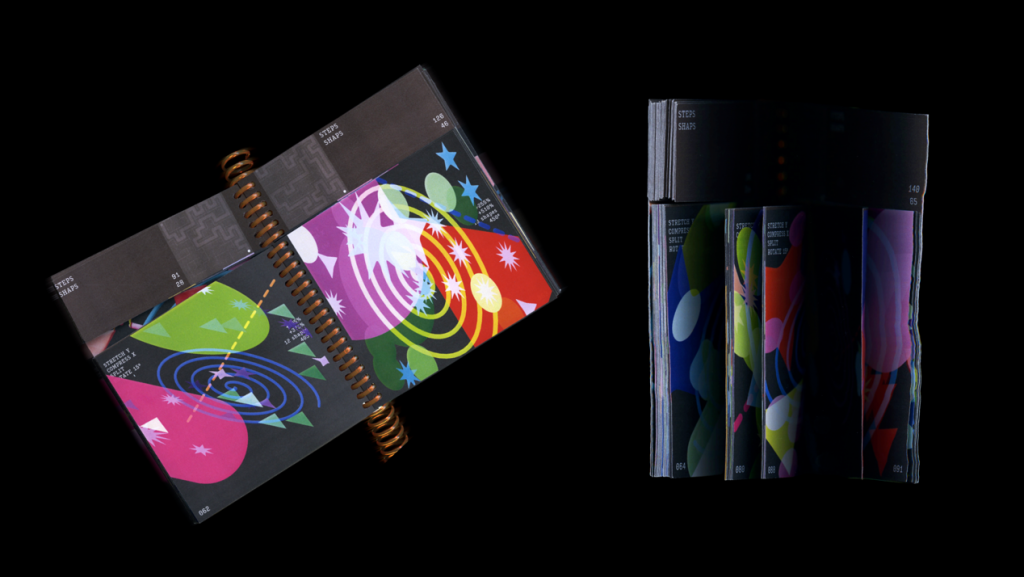
The dialogue also made me reconsider a recurring feature of my practice: digital interactions often return to physical form. I have translated interactive processes into publications or allowed audience activity to become drawing. Morris responded positively to this tendency but asked why I make this transition and what it changes for the audience. This question revealed that moving from screen to paper should not be treated as a neutral method of presentation. When a temporary digital action becomes a printed or material trace, it acquires duration, visibility and a different kind of ownership. At the same time, the designer regains control by selecting, editing and arranging what is preserved. The physical outcome can therefore expose a tension within my enquiry: I may relinquish control while an interaction unfolds, yet reclaim authorship when I frame its results.
Morris’s own project Sandbox makes this physical-digital relationship more concrete. The project brought together a physical and digital exhibition, participatory workshops, public events and an evolving resource archive. Rather than separating online and offline experience, Morris describes both as forms of human interaction and maintains a cyclical connection between them (Taker, 2025). This suggests that translating an experience into another medium does not have to produce a final, fixed object. It can expand the routes through which people enter a project, contribute to it and encounter one another. For my practice, the question therefore becomes not simply how a digital interaction can be materialised, but what new relationships become possible through that translation and which audiences each form enables or excludes.
This changes how I understand the designer’s role. The designer does not truly disappear or surrender authorship; the role shifts from manufacturing every graphic form to organising relations, rules and possibilities. This feels particularly relevant in the context of artificial intelligence and vibe coding. These tools can accelerate production, but design has never been valuable only because it is fast. Its value also lies in connecting contexts, constructing narratives, communicating emotion and creating situations in which different positions can meet or collide. Morris’s emphasis on community, education and criticality, rather than technological perfection, reinforces this position. Her use of accessible tools and intentionally imperfect aesthetics prioritises the story and the conditions for participation over technical mastery (Taker, 2025). As execution becomes easier, the critical design decisions become more visible: who is able to participate, what the system records, how one action affects another, what is excluded, and how the resulting traces are interpreted.
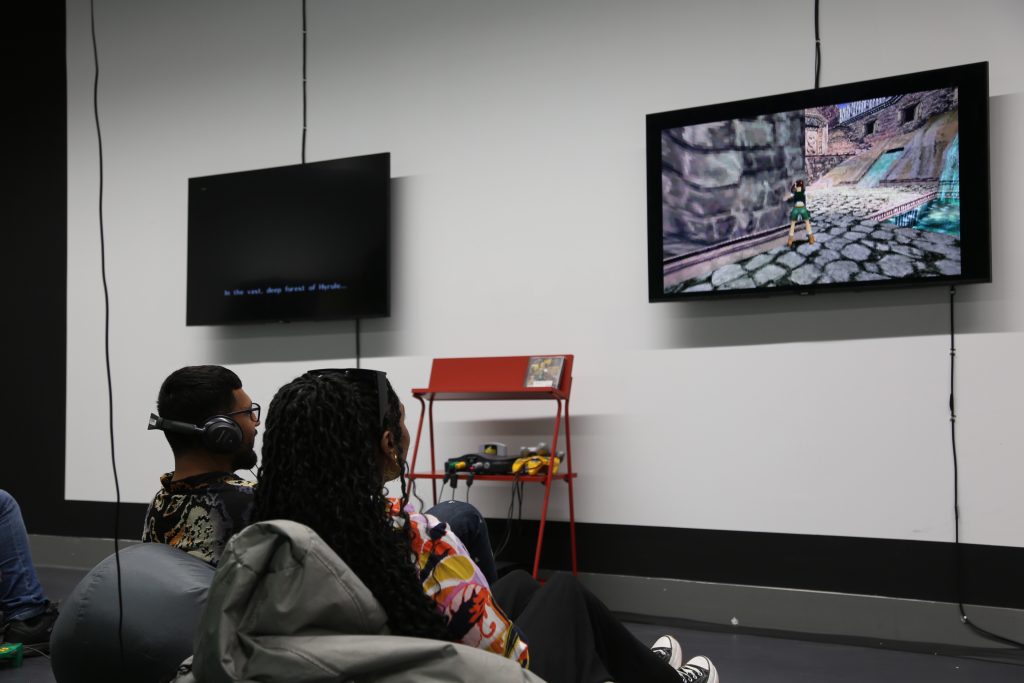
The recommendation to study FACT Liverpool further situated this enquiry within digital art and game culture. Institutions, technologies, technicians and modes of display all influence whether an interactive work can be encountered as art. This adds another layer to the network: meaning is not produced only by the designer and participants, but also by the interface, device, exhibition context and methods of documentation. These are not passive containers; they help determine what kinds of participation are possible and whose actions become visible.
The dialogue did not provide a final answer to my enquiry. More importantly, it changed what I understood the enquiry to be. I am no longer asking only whether participants can generate graphics when the designer steps back. I am asking how a designer can construct a system in which participants generate meaning through one another’s traces, and how digital and physical forms frame that relationship differently. My next stage of practice will therefore continue through relational experiments and conversations with participants. Their responses will help me examine whether they experience another person’s trace as collaboration, restriction, authorship or something else. In this way, dialogue becomes more than commentary on the work: it becomes part of the method through which the work and its questions continue to develop.
References
Chang, S. (2026) ‘we were online’. Available at: https://wewere.online/ (Accessed: 22 September 2026).
Morris, J. (2026) Personal communication with the author, 22 September.
Taker, L. (2025) ‘Slow Play, Shared Futures: an interview with Jazmin Morris about Sandbox’, Corridor8, 1 September. Available at: https://corridor8.co.uk/article/slow-play-shared-futures-an-interview-with-jazmin-morris-about-sandbox/ (Accessed: 22 September 2026).
Positions through Contextualising · Unit 2 · MAGCD Y1
Line of enquiry
When designers relinquish direct control over the visual outcome and instead design a set of rules and structures, can graphics produce meaning through the participants’ behaviour?
1. Conditional Design Workbook
Set the rules first; the result is whatever happens after.
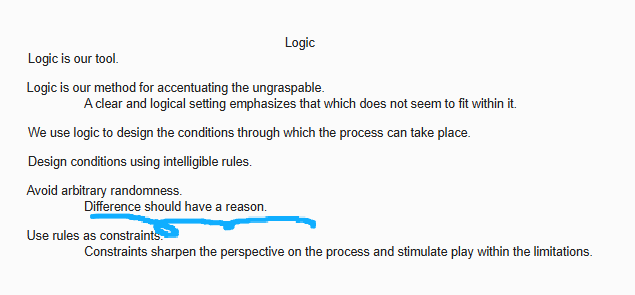
The Conditional Design Workbook, as a working manifesto, tells me that relinquishing visual control does not mean relinquishing design itself — it means relocating design from the outcome to the conditions. This single shift reframes the question my enquiry begins from. But the workbook also issues a warning: “Difference should have a reason.” If the variation my rules generate is illegible to participants, what I have made is not a set of conditions but chaos. This challenges me to evaluate my work not by whether participants are free, but by whether the differences they produce can be read. The reference deepens my understanding by giving rule-based design a working ethics — the designer’s responsibility does not vanish when control is relinquished; it simply moves into the precision of the rule. This single line has become the threshold of my entire experiment.
Blauvelt, A., Maurer, L., Paulus, E., Puckey, J. and Wouters, R. (2013) Conditional Design Workbook. Amsterdam: Valiz.
2. Roland Barthes — ‘The Death of the Author’
Meaning is not deposited by the author; it is produced by the reader.
Barthes argues that meaning is not deposited by the author, but produced by the reader at the moment of reception. This implies a double displacement for my project: the visual outcome is no longer determined by my intention, and its meaning is produced anew at every encounter. Yet Barthes’s framework also exposes a tension I cannot dissolve. He locates meaning in the reader’s act of interpretation, but my enquiry depends on meaning growing through the participant’s behaviour — which is closer to writing than to reading. If the participant configures rules and acts within them, are they reader or author? Barthes does not answer this directly; the participant in my model occupies a hybrid position his binary did not anticipate.
Barthes, R. (1977) ‘The Death of the Author’, in Image, Music, Text. Translated by S. Heath. London: Fontana Press, pp. 142–148.
3. Raymond Queneau — Exercises in Style
One trivial story, ninety-nine retellings, one truth: difference lies in the rule.
Queneau retells one trivial bus anecdote ninety-nine times, each under a different rule of style. The book proves the central premise of my enquiry with clarity: the source of difference lies not in the content but in the rules of telling. Same story, different rule, radically different outcome. This extends my understanding by demonstrating that rule-based work does not require complex inputs — it requires a sharp grammar of constraints. Queneau also reminds me of something easy to forget when celebrating openness: the most productive rules are often the most restrictive. “Relinquishing control” is not a sentimental release into freedom; it is a tightening of the rules through which freedom appears. The book pushes back against my own design with a difficult question — is each constraint card in Dot_t. specific enough to produce categorical difference, or are my rules merely cosmetic, generating only surface variation while leaving the deeper structure unchanged?
Queneau, R. (1998) Exercises in Style. Translated by B. Wright. London: John Calder.
4. Casey Reas — Process Compendium
Three layers behind every rule-based image: Element, Behavior, Process.
Reas separates rule-based visual systems into three operational layers: Element, Behavior, and Process. This grammar extends my understanding by showing that “using rules instead of visuals” is not one move but at least three, each authorable at a different level of openness. Before reading Reas, I treated the abandonment of visual control as a single decision; he gives me a precise vocabulary to see that I have been making three distinct decisions all along, each with its own ethical weight. But Reas’s practice also challenges my position by going somewhere I do not want to go. His systems run autonomously — once defined, they leave the human behind, generating images without further intervention. My project moves in the opposite direction: I want the slower, more irregular kind of meaning that only emerges when a body remains inside the loop. Reas clarifies what I am refusing as much as what I am inheriting.
Reas, C. (2010) Process Compendium 2004–2010. Berlin: [DAM] Gallery. Available at: https://reas.com/compendium_text/ (Accessed: 7 May 2026).
5. Karl Gerstner — Designing Programmes
The maximum of conformity to a rule with the maximum of freedom.
Gerstner observes that if a system contains too many constants, the participant’s behaviour produces only minor variation, and the work appears uniform; if too few, behaviour produces noise rather than meaning. He gives me a precise framework for diagnosing why some rule-based systems generate legible difference while others fall flat. This extends my understanding by reframing my project as an equation to be solved rather than a posture to be adopted — every constraint in Dot_t. must balance constants against variables to remain productive. But Gerstner also issues a quiet challenge to the way I had been describing my own work. He argues that good programmes “make the bad difficult and the good easy” — meaning that the rules carry judgement, even when their visual outcomes are unpredictable. Translated into my enquiry: meaning does not grow on its own from participant behaviour. It grows because the rules I designed were good. The author has not disappeared, only retreated into a less visible position.
Gerstner, K. (2007) Designing Programmes: Instead of Solutions for Problems, Programmes for Solutions. New edition. Baden: Lars Müller Publishers.
6. Anni Albers — On Weaving
The constraint of thread is not a limit on form. It is the source of form.
Albers connects my enquiry to a tradition older than digital interaction. The grid of the loom, the restriction of warp and weft — she insists this restriction does not block the emergence of form; it is the very source from which form emerges. This extends my understanding historically: my proposition that “rules constraining behaviour produce graphics” is not a contemporary invention tied to interactive media. It runs through weaving, printing, drawing, and computation alike — it is a craft logic passed through centuries. But Albers also complicates a clean separation I had been assuming between “designer who sets rules” and “participant who follows them.” The weaver is both, simultaneously, in the same gesture. The loom does not stand outside the body; it acts as both tool and co-author. This troubles a tidier version of my project in which roles are cleanly assigned. Perhaps in Dot_t., these two positions are not separate either — they collapse into the figure who designs and enacts at once.
Albers, A. (2017) On Weaving: New Expanded Edition. Princeton, NJ: Princeton University Press.
7. Claire Bishop — Artificial Hells
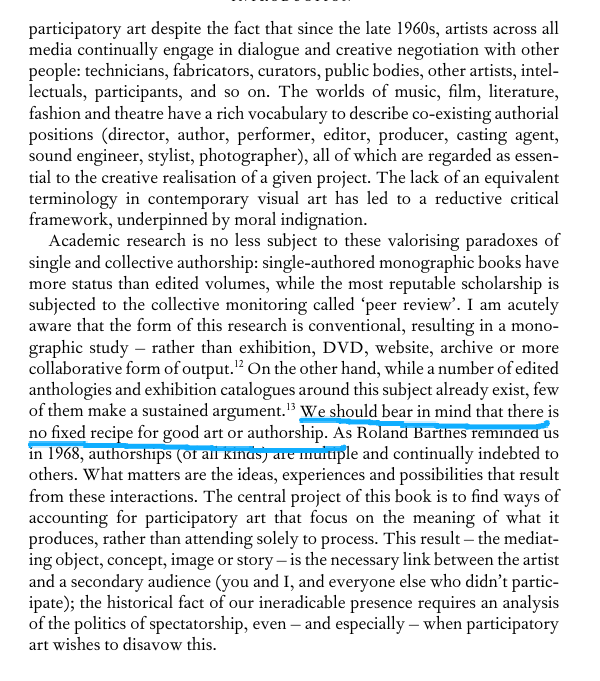
To equate authorship with authority is itself a repressive simplification.
If anyone among these references stands directly against me, it is Bishop. In Artificial Hells, she argues that equating authorship with authority — and then equating the relinquishing of authorship with emancipation — is itself a repressive simplification. Translated into my project, this is the most uncomfortable challenge any reference poses: what I call “the designer stepping back from control” might not be liberation at all, but only a more concealed form of control dressed up as openness. Bishop refuses to let “participation” stand as an inherent good. She insists that participatory work must still be evaluated on aesthetic, political, and ethical grounds, not only on the fact of its participatory structure. This challenges my enquiry at its most vulnerable point — the assumption that less visible authorship is a virtue. Without her, Dot_t. risks sliding into a self-congratulatory “participation equals freedom.” With her, every design decision must justify itself.
Bishop, C. (2012) Artificial Hells: Participatory Art and the Politics of Spectatorship. London: Verso.
8. Sol LeWitt — Sentences on Conceptual Art
The artwork is the idea. Execution can be delegated; authorship cannot.
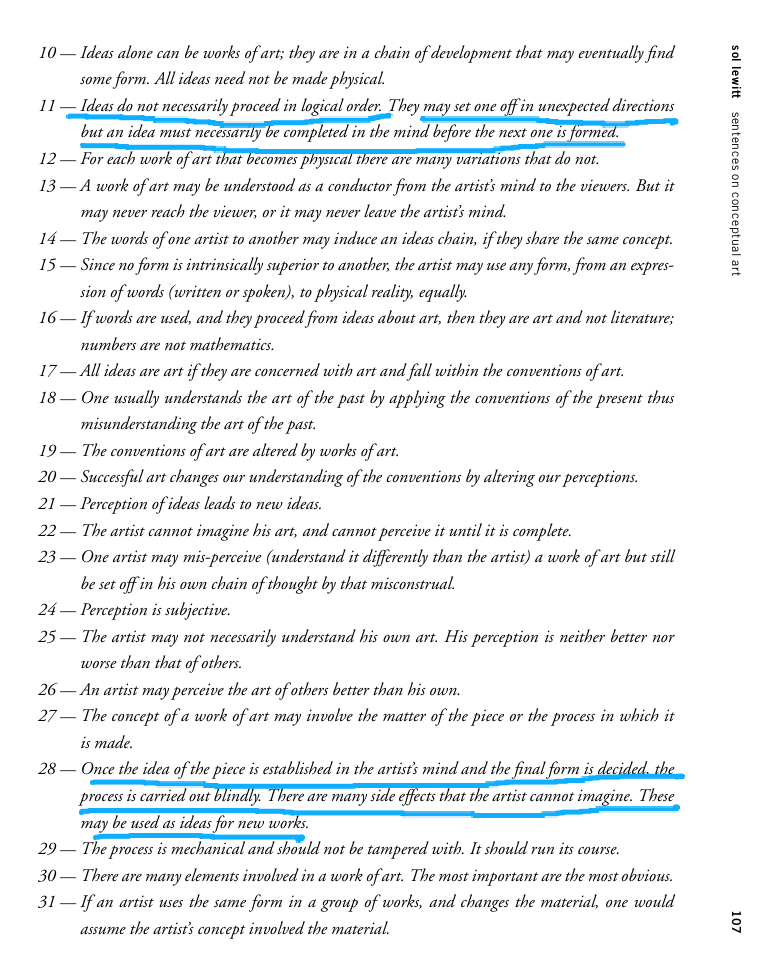
LeWitt holds that the essence of an artwork lies in its idea, not its object, and that execution can be delegated to others without diminishing the artist’s authorship. This extends my enquiry by giving it a historical lineage — long before interactive web projects, conceptual artists were already separating instruction from execution and treating that separation as the artwork itself. In LeWitt’s model, the rule belongs to the artist; only the execution is delegated. In the model my enquiry proposes, the rules themselves can be modified or chosen by participants. LeWitt’s purity makes the difference visible. At one extreme, the artist retains conceptual authorship and the participant becomes a hand; at the other, the artist becomes a frame-maker and the participant becomes a co-designer. My enquiry sets out to examine whether this second position is sustainable as a form of design — or whether, beyond a certain threshold of openness, the work dissolves into mere infrastructure. LeWitt makes that threshold something I can name.
LeWitt, S. (1969) ‘Sentences on Conceptual Art’, 0–9, (5), pp. 3–5.
9. Studio Moniker — Do Not Touch
A framework, a prompt, ten thousand cursors becoming one image.
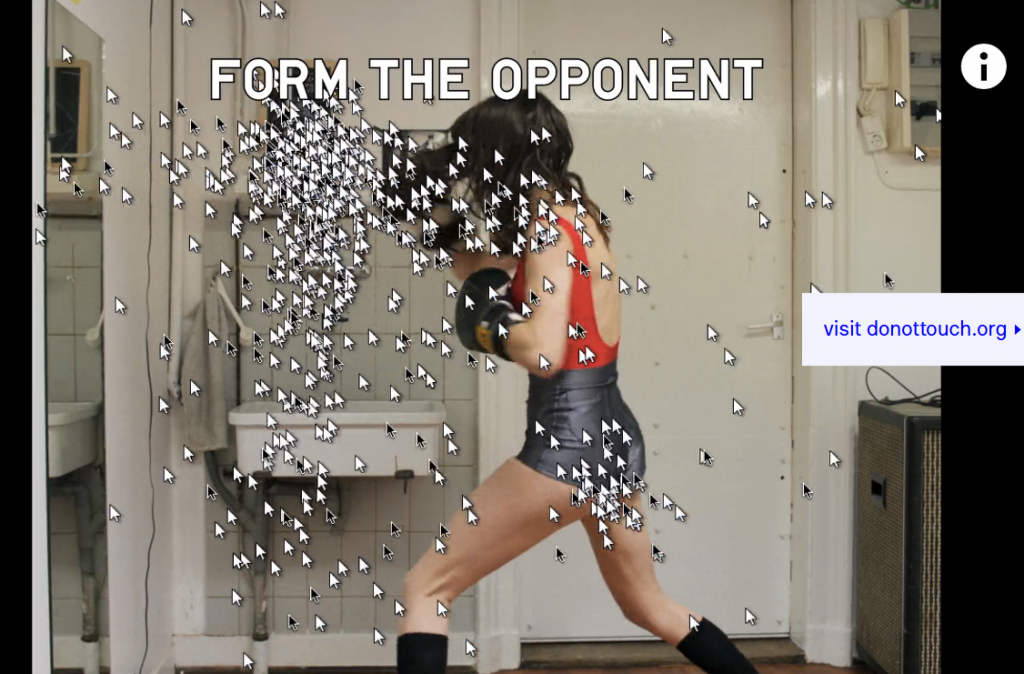
Of all my references, no project sits closer to Dot_t. in structure than Studio Moniker’s Do Not Touch — a framework, textual prompts, recorded cursor behaviour, accumulated into a collective image. It did, twelve years before me, what I am attempting now. The reference extends my understanding by demonstrating that this kind of system can actually work — meaning genuinely emerges from participant behaviour at scale. But it also shows me what I do not want. In Do Not Touch, every individual gesture dissolves into a sea of cursors, and participation becomes spectacle rather than signature. This challenges my enquiry by surfacing a fork I had not articulated: meaning grown through behaviour can take at least two forms — collective patterning, as in Moniker, or individual rhythm, a different mode worth investigating. The design moves required for each are not the same. Moniker’s prompts are written to elicit aggregable response; an individual-rhythm version must reward divergence. Do Not Touch is my sibling project, and also my reverse coordinate.
Studio Moniker (2013) Do Not Touch [interactive music video]. Available at: https://studiomoniker.com/projects/do-not-touch (Accessed: 7 May 2026).
10. Hans Ulrich Obrist — do it: The Compendium
A score is an instruction; an instruction is an artwork waiting to be enacted.
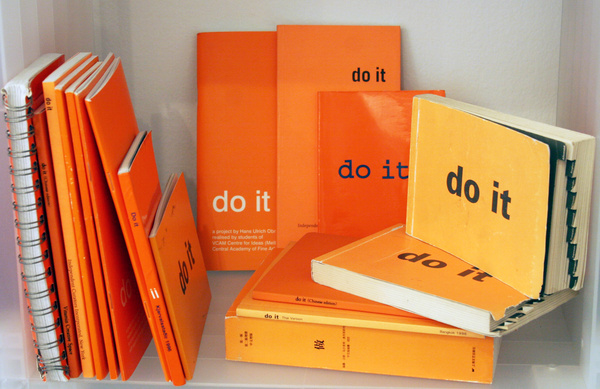
Obrist’s do it shows me a scale I had not been thinking about. The project — artists submit written instructions (“scores”) that can be enacted anywhere by anyone — operates on a global, twenty-year, three-hundred-artist scale. The same instruction enacted in Tokyo, Reykjavík, or Lima produces radically different outcomes that remain recognisably “the same” piece. This reframes my central question: meaning may grow through participant behaviour not only within a single instance of a work, but across many instances of it, accumulating across geographies and cultures. The reference also troubles a quiet assumption I had been making — that participant behaviour requires real-time interaction with a designed system. do it shows that interpreting a written instruction over hours or days is also behaviour, and the resulting work is no less rule-based for the temporal gap. The archive of Dot_t. should be imagined on this longer scale — not as a session log, but as a slow accumulation across many hands.
Obrist, H.U. (ed.) (2013) do it: The Compendium. New York: Independent Curators International / D.A.P.
11. Aaron Koblin — The Sheep Market
A simple rule, ten thousand sheep, and a question of who owns participation.
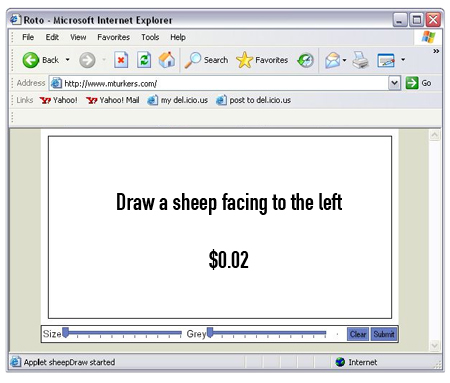
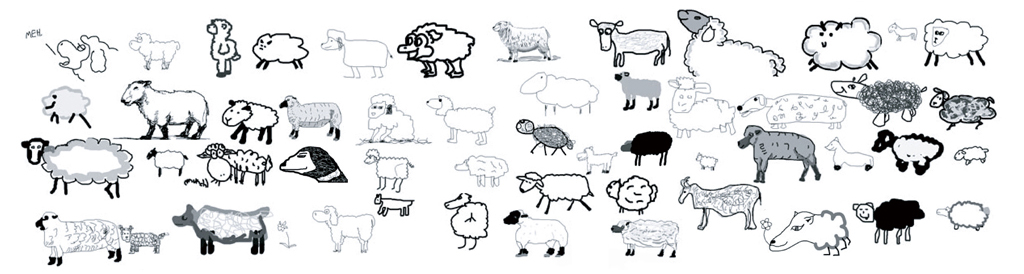
The Sheep Market sits in two opposite places at once within my enquiry. It confirms my central hypothesis: Koblin controlled none of the 10,000 sheep visually, and yet a single minimal rule — “draw a sheep facing left, two cents per drawing” — generated 10,000 entirely distinct images, each emerging from the judgement of a participant he never met. But it also enacts what Bishop, in Artificial Hells, calls “outsourcing authenticity.” Koblin later resold the sheep at twenty dollars each. The original workers protested in a Mechanical Turk forum thread titled “They’re selling our sheep!!!” This forces me to face a question my enquiry had been avoiding: when participants generate graphics through their behaviour, who owns those graphics? The Sheep Market is not a model I imitate, but a coordinate I work against. It compels me to address three things in Dot_t.: explicit acknowledgement of authorship, the non-commodification of participants’ traces, and the independent accessibility of every individual work in the archive.
Koblin, A. (2006) The Sheep Market [online interactive project]. Available at: http://www.aaronkoblin.com/work/thesheepmarket/ (Accessed: 7 May 2026).
12. Tim Ingold — Lines: A Brief History
Walking, weaving, drawing, writing — all are variants of a single thing: the line.
Ingold provides my enquiry with the conceptual vocabulary it had been operating without. He treats walking, weaving, drawing, and writing as variants of a single category — the line — and supplies precise terms to distinguish different kinds of lines. When I ask whether graphics can grow meaning through participants’ behaviour, I am implicitly assuming that behaviour leaves a trace, and that the trace itself is the work. Ingold complicates this assumption: not all behaviour leaves a trace, and not all visible lines are traces of behaviour. His writing also poses a critical question: am I designing systems that allow wayfaring — open, exploratory, irregular — or systems that disguise transport (goal-directed movement) as wayfaring? This distinction extends my understanding by giving me a tool to audit my own design. By offering participants explicit “points” and “connections,” I may have already structured the experience as transport while claiming the rhetoric of wayfaring. Ingold becomes the conceptual instrument with which I keep my project honest.
Ingold, T. (2007) Lines: A Brief History. London: Routledge.
Critical Analysis 1
Claire Bishop, Artificial Hells: Participatory Art and the Politics of Spectatorship (2012)
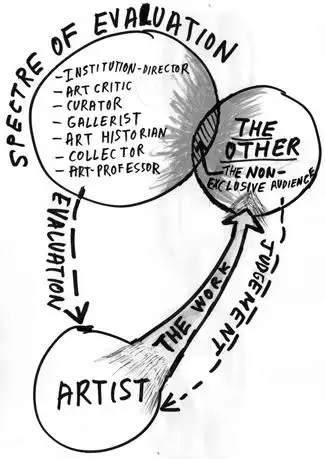
My enquiry begins from a question: when designers relinquish direct control over the visual outcome and instead design a set of rules and structures, can graphics produce meaning through the participants’ behaviour? When I first formulated this question, I was confident the answer was yes. Bishop’s Artificial Hells is the text that has most thoroughly destabilised that confidence. Her central argument is that contemporary art criticism has been operating under what she calls the “ethical turn” — a habit of judging participatory works by the moral posture of the artist rather than by the aesthetic, political, or intellectual force of the work itself. She traces this turn to a chain of equivalences she finds repressive: participation is treated as inherently emancipatory, authorship is treated as inherently authoritarian, and so the relinquishing of authorship is treated as a moral good. Bishop’s position is not anti-participation. It is a defence of judgement, and it lands directly on the assumption underwriting my enquiry — that meaning emerges from participant behaviour as a matter of course.
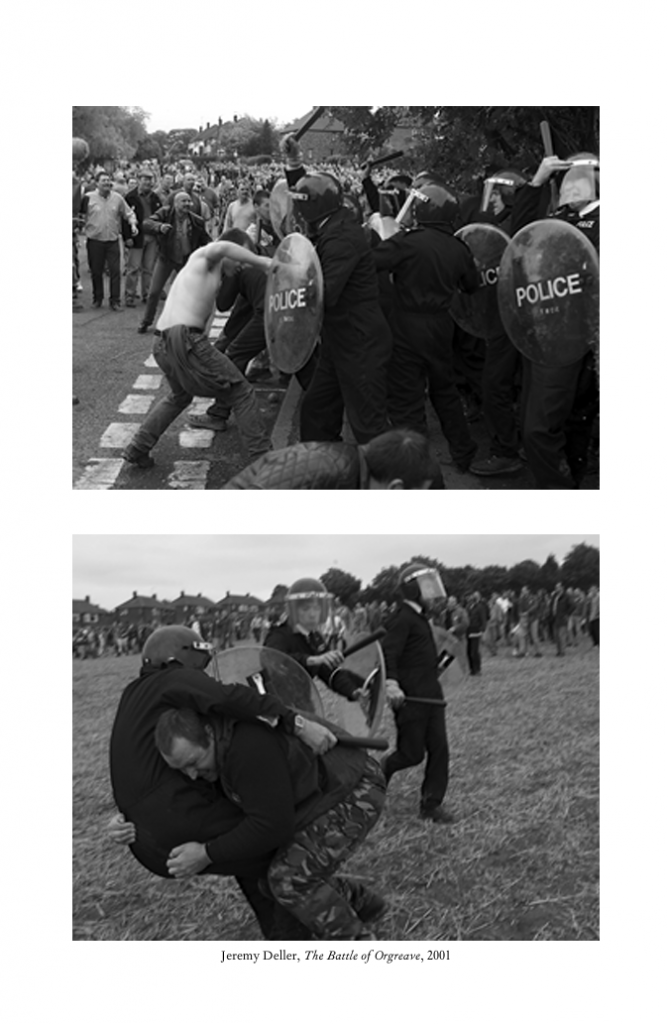
The book’s formal qualities sustain this argument structurally. Contemporary participatory-art criticism tends to focus on specific success stories — how a particular work brought a community together, how a particular act of participation moved its audience. Bishop refuses this case-by-case celebratory approach. Instead, she constructs a dialectical historical apparatus across nine chapters that move from the Italian Futurists through Soviet avant-gardes, the Situationist International, 1990s relational aesthetics, and into contemporary delegated performance. By the time the reader arrives at the present, they have been equipped with a century of comparable claims against which to test current rhetoric. The images she selects sustain this position too — archival black-and-white records of historical performances and actions, rather than the warm colour photography conventional in contemporary participatory-art catalogues. The reader is positioned as a historian rather than as a sympathetic visitor. The book’s material form, in other words, performs its own thesis: it asks the reader to think before it allows them to feel.
Bishop writes within the contemporary-art context, but her critique reaches into graphic and communication design too. The discipline has absorbed much of the same language she dismantles — co-design, participatory workshops, design-for-good — without consistently testing what those words mean in practice. The figure of the “facilitator-designer,” modest and humane, who merely sets up the conditions for participants to find their own voice, is a position the design world tends to celebrate rather than examine. The shift Bishop has forced in my own thinking is small but decisive: the question I now ask of any participatory design work, including my own, is not “did the designer give space?” but “can the designer name, one by one, the decisions they made?”
The participants’ input — their words, traces, pauses, accelerations, connections — was always theirs, not mine to grant. More importantly, the project’s most authored decisions are the ones the participant cannot see: the rule that the first and last words must be connected, the randomness of the constraint cards, the way lines are eventually translated back into language. These shape the entire experience but never present themselves as decisions. They feel like the environment. What Dot_t. rejects — through its word-chaining mechanism and its continuous, hand-drawn lines that pass between participants — is the version of the error Bishop identifies as most repressive: the version in which authorship is most powerful precisely because it has been most thoroughly denied. The chain itself is the answer. Each participant inherits the previous person’s last word and draws their next line from where that person’s line ended. Authorship is neither held by the designer alone nor dissolved into anonymity; it is passed, visibly, from one hand to the next.
What Bishop has given me is not an answer to my enquiry, but a sharpened version of the enquiry itself. Where I began by asking whether graphics can produce meaning through participants’ behaviour, I now ask where that meaning emerges and how a designed system must be structured to hold its emergence open. My current hypothesis is that meaning does not surface from any single act of participation, but in the chain of responses between participants — in the words one person leaves for another to pick up, in the line one person ends so another can begin. Dot_t. is the system I am building to test this. Bishop has not closed the question; she has changed its grammar.
Critical Analysis 2
Aaron Koblin, The Sheep Market (2006)
In 2006, Aaron Koblin posted a task on Amazon Mechanical Turk: draw a sheep facing left, two cents per drawing. Within forty days, 7,599 anonymous workers had produced 10,000 sheep, arranged into a single browsable grid in which each sheep, on hover, replays the act of its making. The Sheep Market is the most explicit confirmation I have found that the answer to my enquiry can be yes. A single minimal rule, distributed across thousands of acts of interpretation, did generate a richly varied visual archive that no individual designer could have specified. To this extent, The Sheep Market is one of the most important precedents for Dot_t. Both works share a fundamental condition: they are interactive systems that exist on the internet, and they treat participants’ actions — the cursor, the hand, the line — as the medium through which the work is made. The internet is not just where the work is hosted; it is the surface on which participation happens.
The formal qualities that make this comparison possible are the medium, the mode of production, and the mode of circulation — all three of which Koblin treats as part of the work’s argument rather than as neutral logistics. The choice of Mechanical Turk as a medium is itself a position. The platform allowed Koblin to convert the internet into a distributed studio — thousands of hands across the world, mediated only by a browser and a small drawing tool. The drawing tool gave each worker a square canvas, a colour, and the ability to produce one image. The mode of circulation completes the structure: the 10,000 sheep are arranged in a single grid, and the replay animation reanimates each act of making, frame by frame. This formal decision — to record not only the finished sheep but the process of each drawing — is what gives the work its character. The viewer sees not just a picture but a person drawing it.
For graphic and communication design as a field, The Sheep Market belongs to a small but important lineage of works that treat the browser as a site for collective making — alongside Studio Moniker’s Do Not Touch and the broader tradition of net-based participatory projects. What this lineage demonstrates is that participation on the internet does not have to follow the dominant logic of social-media platforms, where individual contributions are aggregated into feeds, metrics, and algorithmic visibility. Koblin shows that the browser can hold collaborative authorship in a quieter, more deliberate form — one where a single rule is enough to generate a visible community of acts. Reading The Sheep Market within this lineage rather than in isolation opens a question for participatory design more broadly: what would it mean to design online participation that does not depend on social-media affordances at all?
Where Koblin’s project and Dot_t. begin to diverge is in the kind of authorship the participant is offered. In The Sheep Market, the rule is fixed by the designer — every participant is asked to draw the same thing, a sheep facing left, and the variation appears only at the level of execution. The participant interprets the rule but does not modify it. In Dot_t., the participant is given a more substantial form of agency. They choose their own sentence, decide which word to pass on, and determine where in the canvas their line begins and where it ends. Each contribution carries not only a personal gesture but a personal decision about what is worth contributing in the first place. This is a small shift in the structure of participation but a significant one in terms of what gets produced. The Sheep Market generates a sea of variations on a single theme; Dot_t. generates a sequence of related but distinct themes, each chosen by the participant who introduced it.
The reflection this comparison produces is about the kind of collaboration each mode of participation enables. Koblin’s participants do not collaborate with one another — they each respond independently to Koblin’s rule, and the work emerges from the aggregation of their parallel acts. There is no contact between any two workers. Dot_t. sets up a different relationship: participants collaborate sequentially, with each contribution shaped by the one before it. The chain is the form of collaboration. The previous person’s last word becomes the next person’s first; the previous person’s last line becomes the next person’s first stroke. This means that in Dot_t. a contribution is never just submitted into an aggregate — it is passed to another participant who must read it, take it up, and continue from it. Koblin shows me what is possible when many hands make the same thing in parallel; Dot_t. is the experiment in what happens when those hands instead make in response to each other. The lesson I take from The Sheep Market is not what to avoid, but what kind of collaboration the internet still has space for — collaboration that is slow, sequential, and visibly between people.
When designers relinquish direct control over the visual composition and instead design a set of rules and structures, will the graphics generate meaning through the participants’ actions?
I explored this question by building a maze-generating tool. In the first week, acting as the creator of the rules governing graphic changes, I conducted 100 visual iterations. However, since all 100 images shared the same visual DNA (six basic shapes), the differences in the results stemmed solely from the paths taken. In the second week, I opened the rules themselves to the user: shapes, mappings, materials, and blending modes could all be customized, while the walking process was recorded as a replayable animation—the rhythms of pauses, hesitations, and accelerations were preserved as behavioral fingerprints.
As a purpose-driven structure, the maze forces players to shift their attention from “what result do I want” to “where do I go next.” This project does not judge the rightness or wrongness of a path; it makes the process itself visible. I seek to demonstrate that design is not merely about controlling the outcome; designing a framework that allows the process to take shape is, in itself, a form of creation.
Annotated Bibliography
Reference 1
Course Reading List – Situating the project in a broader discourse
(a) Academic Citation:
Blauvelt, A., Maurer, L., Paulus, E., Puckey, J. and Wouters, R. (2013) Conditional Design Workbook. Amsterdam: Valiz, pp. ii–xiv.
(b) Sampled Detail:
“Design conditions using intelligible rules. Avoid arbitrary randomness. Difference should have a reason. Use rules as constraints. Constraints sharpen the perspective on the process and stimulate play within the limitations.”
(c) Statement (how this detail contributes to my understanding):
The Conditional Design Manifesto states “avoid arbitrary randomness. Difference should have a reason.” This methodology guided the construction and iteration of my Graphic Maze. In Week 1, the maze game rules were fixed (↑ = stretch, ← = split); within these limited operations, the final graphic varied according to differences in walking path. Week 2 expanded the scope of the rules — making the rules themselves user-configurable: users select a mapping for each of the four directional keys from an action menu (rotate, stretch, hue shift, jitter, etc.), then choose their own shape combinations, blend modes, and textures from a shape library. This means the second week’s iteration operates on a dual level — the rule level (different users select different mapping combinations) and the path level (different walking behaviour under the same rules), allowing individual intuition and experience to manifest more distinctly within the maze’s rule framework.
The Manifesto also states “the process produces formations rather than forms.” The second week’s maze game records each walk as sound and animation: when the maze ends, the webpage plays back not a final image but the walking process itself — pauses, backtracking, even walking speed are all preserved in the animation’s rhythm. The final output is no longer a static form but a dynamic formation.
Reference 2
Course Reading List – Situating the project in a broader discourse
(a) Academic Citation:
Barthes, R. (1977) ‘Death of the Author’, Image, Music, Text. London: Fontana Press, pp. 143–148.
(b) Sampled Detail:
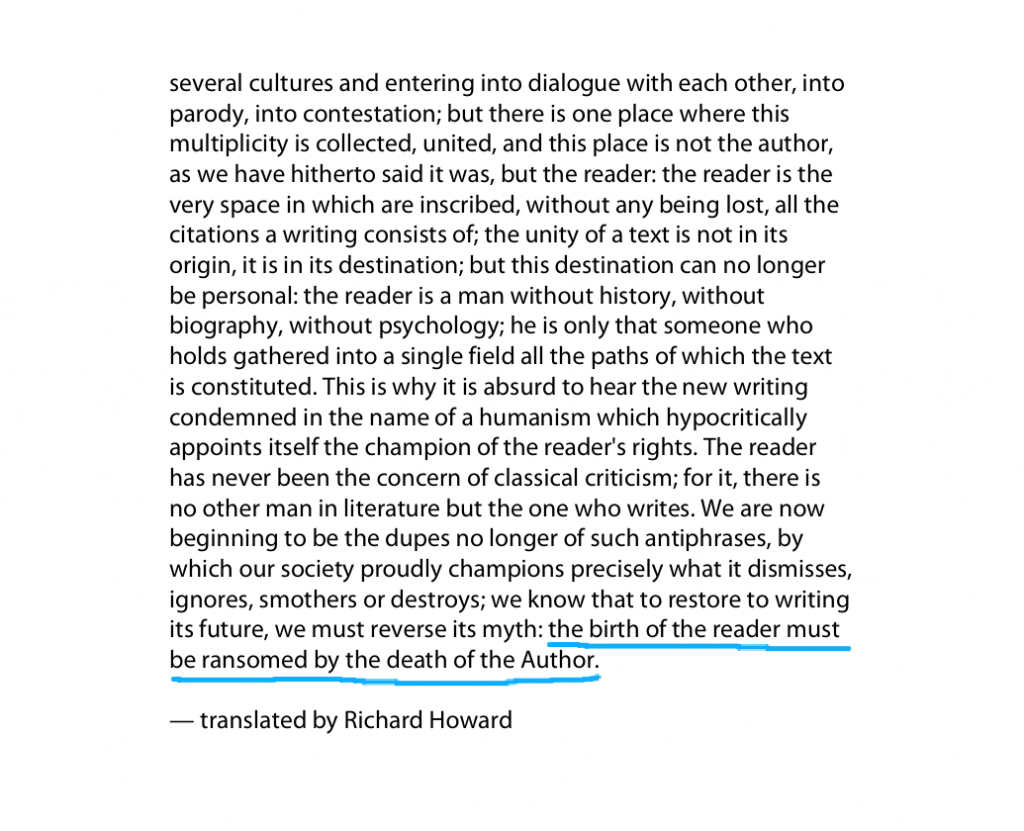
“The birth of the reader must be at the cost of the death of the Author.”
(c) Statement (how this detail contributes to my understanding):
Barthes declared the “death of the Author” — a text’s meaning is determined not by the author’s intention but by the reader’s reception. In my project, “the death of the Author” occurs twice. The first time, in Week 1: I designed a fixed rule system but relinquished control over composition — the visual outcomes of 100 images were entirely determined by the walker’s path. I, as “author of the image,” died; the walker became the “reader/writer.”
The second time, in Week 2: I surrendered even the authority over the rules themselves — users now choose their own shape combinations, colours, sizes, blend modes, and textures. I, as “author of the rules,” also died, leaving only a framework designer. Barthes writes “the birth of the reader must be at the cost of the death of the Author” (p.148); in Week 2 this “birth” is more complete — users are not only executing (walking the maze) but also designing (configuring rules), and the final playback animation turns their walking process into a “text” viewable by a third party. The person watching the playback becomes yet another layer of “reader.” The author’s position keeps receding; the reader’s role keeps expanding — from walker to rule-maker to viewer, each layer produces new meaning.
Reference 3
Topic-related – Specifically related to the project’s theme (how rule variation within a fixed framework produces difference)
(a) Academic Citation:
Queneau, R. (1998) Exercises in Style. London: John Calder. [1947], pp. 9–16, 19–26.
(b) Sampled Detail:
“What particularly struck Queneau about this piece was that, although based on a rather slight theme, its variations proliferated almost to infinity.”
(c) Statement (how this detail contributes to my understanding):
Queneau took an utterly unremarkable bus anecdote — a man has a minor altercation with another passenger, then two hours later is seen at a station being advised to replace a button on his overcoat — and, by changing the rules of telling (style), generated 99 radically different texts: telegraphic, metaphorical, retrograde, olfactory, mathematical. His inspiration came from Bach’s Art of the Fugue: a simple theme whose variations “proliferated almost to infinity.”
This maps directly onto the structure of my maze project: the maze framework is “the unchanging story,” the user-configured rule set (shape combination, directional mapping, blend mode, texture) is “the style of telling,” and each walk’s generated graphic and animation is “a new version.” Queneau’s experiment proves one thing: the source of difference lies not in the content itself but in the rules applied to the content. The visual gap between his 99 styles is far greater than the gap between 99 retellings of the same story — because what he changed was structural (grammar, perspective, rhetorical strategy), not surface-level (word choice, phrasing). This corresponds to my transition from Week 1 to Week 2: Week 1’s 100 iterations changed only the path (surface level), resulting in high visual similarity; Week 2 opened the rules themselves to users (structural level), and difference naturally increased.
As a co-founder of Oulipo (Ouvroir de littérature potentielle), Queneau’s core methodology is “constraint breeds creativity” — under strict formal limitations, creators are forced to invent new modes of expression. The maze walls are exactly this kind of constraint: you cannot pass through walls; you must choose among limited forks. It is precisely this constraint that gives each step its weight, making the final output not random but structured.
Reference 4
Medium/Method-related – Specifically related to the project’s medium or method
(a) Academic Citation:
Reas, C. (2010) Process Compendium 2004–2010. Berlin: Gallery [DAM].
(b) Sampled Detail:
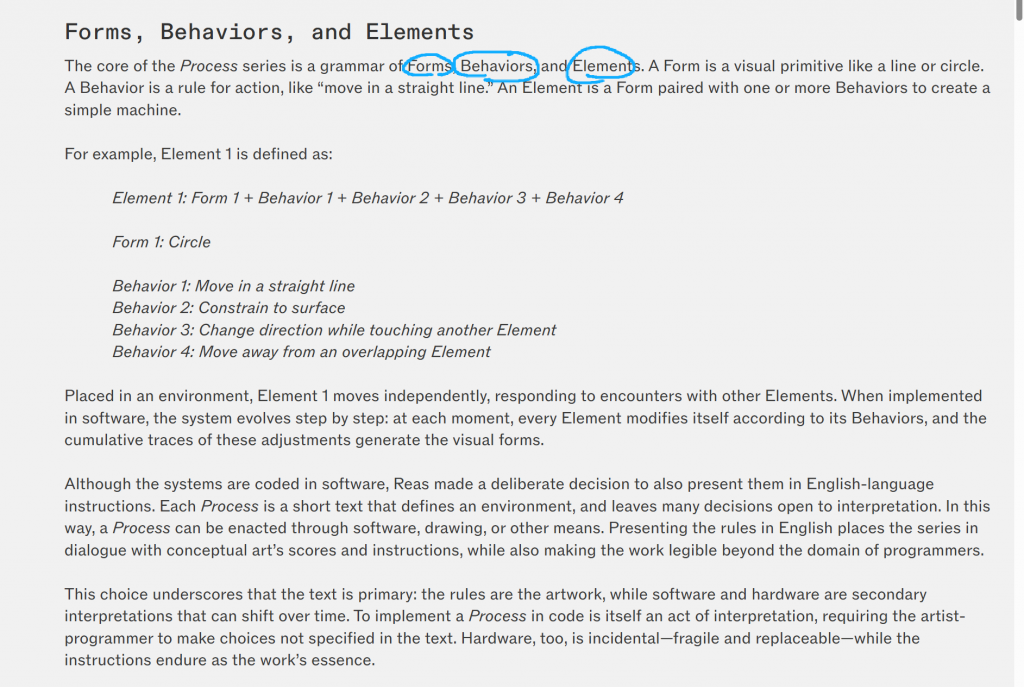
“An Element is a simple machine that is comprised of a Form and one or more Behaviors. A Process defines an environment for Elements and determines how the relationships between the Elements are visualized.”
(c) Statement (how this detail contributes to my understanding):
Casey Reas’s Element–Behavior–Process framework maps directly onto my project’s methodology. In Week 1, this mapping was fixed: six basic shapes were Elements, four directional transforms were Behaviors, and the maze was the Process environment. But Week 2’s customisation system introduced a critical shift: users no longer merely execute within a preset Process — they create their own. They select Elements from the shape library (circle, square, triangle, diamond, star, hexagon, line, spiral, etc. in any combination), configure Behaviors from the action menu (rotate, stretch, hue shift, split, pulse, etc.), and choose textures and blend modes to determine the visual relationships between Elements. Each user effectively defines a unique Process.
Reas argues that the rules themselves are the artwork — an instruction does not point to a single image but opens a space of infinite variations. My system pushes this logic one step further: difference arises not only from different runs under the same rule set, but from each user defining a different rule set altogether. At the same time, Reas’s systems are autonomous — once the rules are set, the algorithm runs independently and the human steps away; my system demands that the person makes real-time choices inside the maze, each step an irreversible decision. The playback animation faithfully preserves the traces of this participation: pauses, accelerations, hesitations — rhythms that no algorithm can generate. They are behavioural fingerprints, and they are what this iterative experiment is truly trying to record.
Reference 5
Critical Position – Demonstrating a critical position in context of the project’s topic, medium, or method
(a) Academic Citation:
Gerstner, K. (1964) Designing Programmes. Zurich: Arthur Niggli. (Reissued 2007 by Lars Müller Publishers.)
(b) Sampled Detail:
“The difficulty is: to find the balance, the maximum of conformity to a rule with the maximum of freedom. Or: the maximum of constants with the greatest possible variability.”
(c) Statement (how this detail contributes to my understanding):
Gerstner’s central question — the balance between “the maximum of conformity to a rule with the maximum of freedom” — runs through both weeks of my iteration. Week 1 tutor feedback noted that the 100 iterations showed excessive visual similarity. Diagnosed through Gerstner’s framework: the problem was that Week 1’s programme had too many constants (fixed six shapes, fixed four mappings, fixed lighten blend mode) and only one variable (the path), causing “conformity” to overwhelm “variability.”
The Week 2 iteration directly addressed this diagnosis — turning most of the programme’s constants into user-selectable variables. Shape combinations, directional mappings, blend modes, textures, backgrounds, and text overlays are all open to user configuration. The framework (maze structure + directional keys + canvas) remains constant; the rule content becomes variable. This is a new realisation of what Gerstner called “the maximum of constants with the greatest possible variability.”
But Gerstner’s framework also poses a new critique of Week 2: he wanted a programme that “makes the bad difficult and the good easy.” My system makes no such distinction — all configuration combinations and all walking paths are treated as equivalent. Is this design openness, or an abdication of “design judgment”? Gerstner’s programme is optimising; mine is neutral. This neutrality may itself be my project’s critical position: the system does not judge actions as right or wrong — it simply makes the process visible.
Reference 6
Wild Card – Cross-media connection: from textile to code, path choices within grid constraints
(a) Academic Citation:
Albers, A. (1965) On Weaving. Middletown, CT: Wesleyan University Press. (Reissued 2017 by Princeton University Press.)
(b) Sampled Detail:
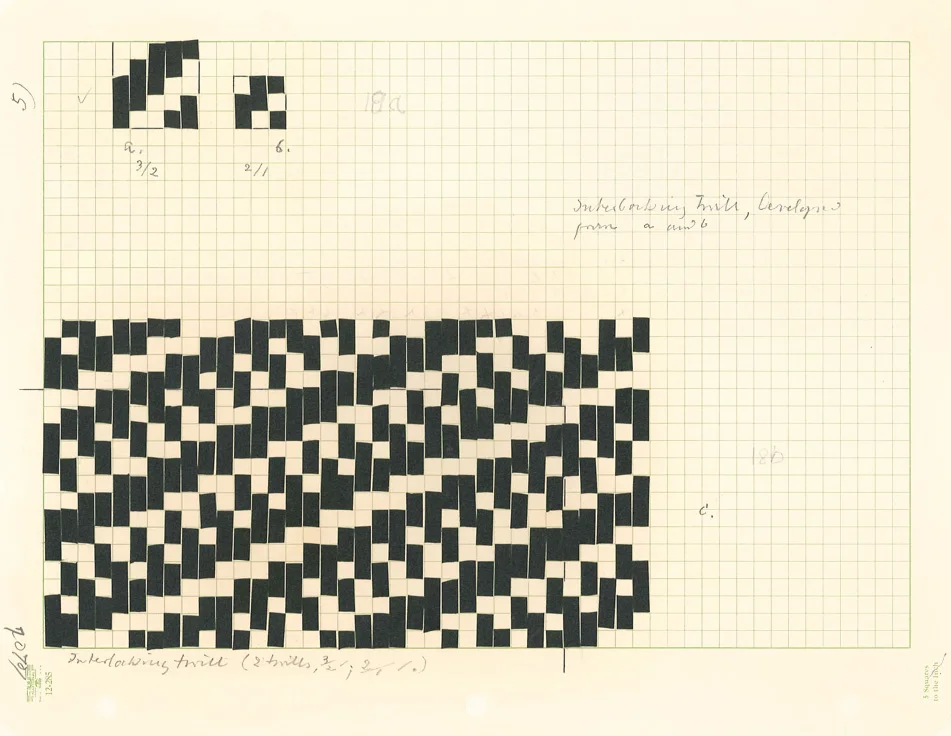
“Being restricted to the use of thread forced me to find a way of dealing with form that resulted from the characteristics of this material. That was a tremendous help to me, as I think it probably can be to anybody, as long as you, at the same time, are concerned with breaking through it.”
(c) Statement (how this detail contributes to my understanding):
Anni Albers treated the loom’s grid constraint as both a “railing” and a creative starting point — an attitude that mirrors my use of the maze exactly. Weaving and my project are structurally parallel: the orthogonal relationship of warp and weft corresponds to the maze’s horizontal and vertical passages; the weaver’s shuttle choices at each row correspond to directional choices at each fork; the textile’s pattern is an accumulation of paths, just as my graphic is an accumulation of walking.
In Week 2, Albers’s insight becomes more concrete. She said a weaver “must think structurally instead of simply designing the patterns that appear on the surface” — the process of users configuring rules in Week 2 is exactly this kind of “structural thinking”: choosing which shapes, which blend mode, which action each direction triggers. These decisions constitute the “threading pattern” of the textile. Different users’ configurations are like different threading patterns; the same loom (maze framework) produces entirely different fabrics. Critics have described Albers’s textiles as “programmed images” — before the computer existed, the loom itself was a programming device. My project relocates this ancient “path-choice-within-a-grid” from physical fibre to digital canvas, and Week 2 goes further — not only is the path selectable, but the “programming language” itself (the rule set) can be redefined by the user. From the 19th-century Jacquard loom to 21st-century creative coding, path choice under grid constraint remains the fundamental mechanism for producing visual diversity.