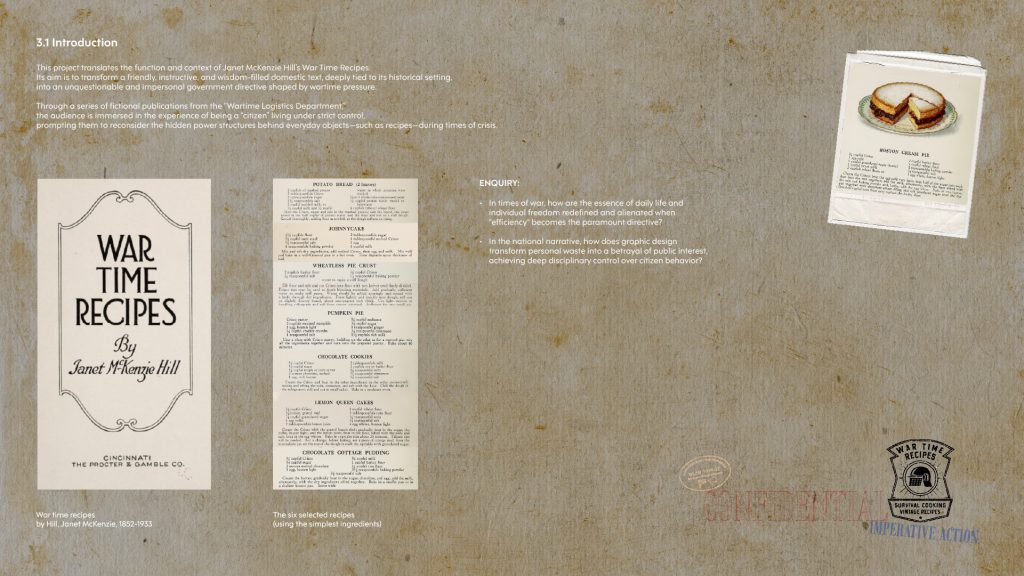
This project translates the function and context of Janet McKenzie Hill’s War Time Recipes. Its aim is to transform a friendly, wisdom-filled domestic text, deeply tied to its historical setting, into an unquestionable and impersonal government directive shaped by wartime pressure.
Through a series of fictional publications from the “Wartime Logistics Department,” the audience is immersed in the experience of being a “citizen” living under strict control, prompting them to reconsider the hidden power structures behind everyday objects—such as recipes—during times of crisis.
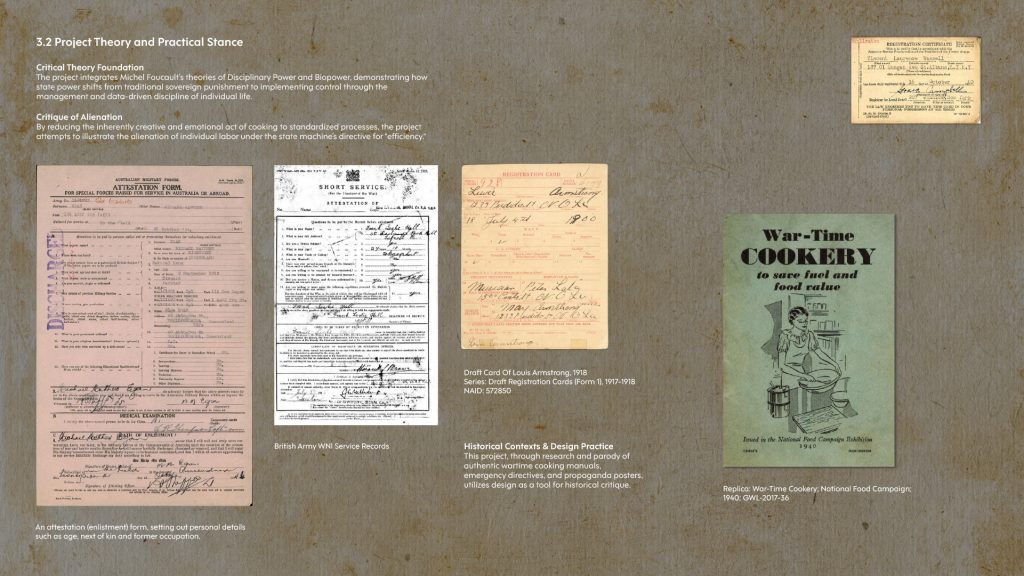
To achieve this, I employed two primary translation methods:
Contextual & Rhetorical Shift: The recipe is displaced from the domestic kitchen—a private space—to a wartime logistics unit. Consequently, the original, friendly cooking language is rewritten into official, verbose, and authoritative military discourse.
Parodying: I parodied the linguistic style and visual aesthetics of early 20th-century government documents, military manuals, and bureaucratic texts. This serves as a critical method to reveal the power and control embedded within these media forms.
For the selection of content, and taking the wartime context into account, I picked six recipes whose ingredients and preparation methods are relatively simple to obtain and execute.
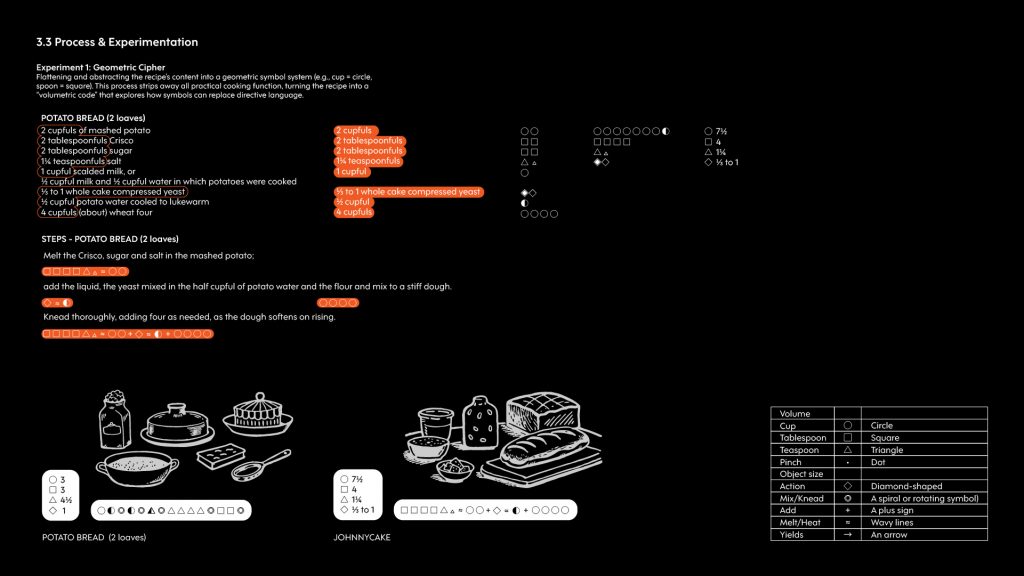
While reviewing these recipes, I noticed that many ingredients require cutting into quarters or thirds, prompting me to visualize these measurement conversions. This approach attempts to translate the recipe’s experiential language into a concise, abstract geometric symbol system. I assigned corresponding geometric shapes to each volume unit: for instance, a cup is represented by a circle, a tablespoon by a square, and a teaspoon by a triangle. I also designed dedicated symbols for cooking actions—like operators connecting ingredients. For instance, stirring is represented by a spiral, adding by a plus sign, and melting or heating by a wavy line.
By using this method, the practical function of the recipe is completely stripped away and transformed into a volume cipher. This translation flattens three-dimensional volume into a plane and explores how symbols can substitute for prescriptive language.
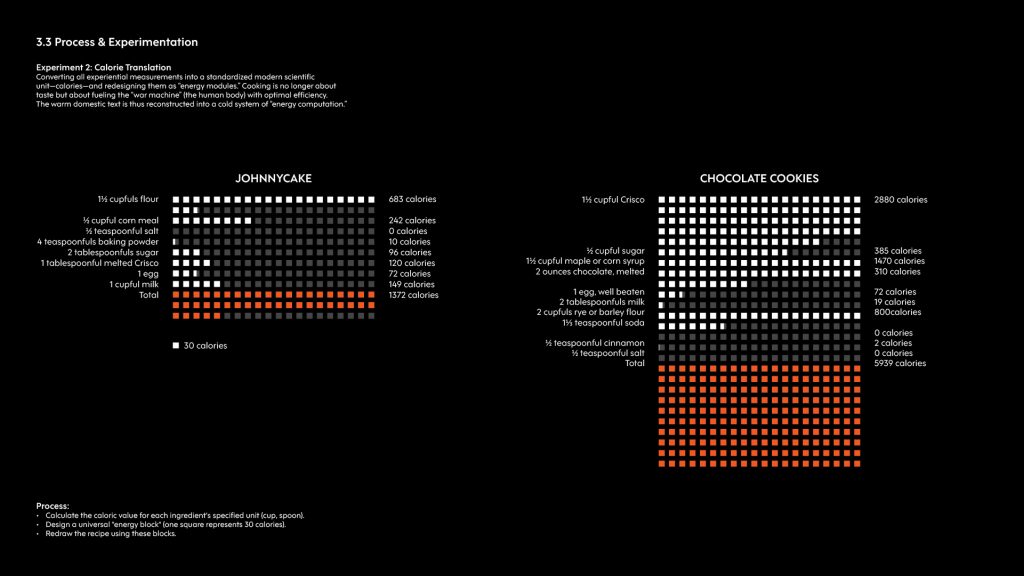
The next experiment involves converting all recipe units to the universal energy unit—calories.
Given their historical context, units like “full cup” and “full spoon” are neither abstract nor precise. They are not abstract because they correspond to actual physical tools used in kitchens at the time. However, by modern standards, they represent non-standardized, empirical measurements whose volumetric values differ significantly from modern precision measurements. This conversion method uniformly transforms all traditional empirical volume units in recipes (such as “cups” and ‘spoons’) into the scientific modern unit—calories. By designing “energy blocks,” recipes are restructured into a visual representation of energy values.
By translating recipe units into “calorie blocks,” I aimed to respond to the specific historical context of the wartime cookbook and visualize the central wartime function of food — supplying energy. The warm, experience-rich, domestic text is reconstructed as a cold calculation of energy efficiency. The purpose of cooking is no longer flavor or tradition, but to provide optimized fuel for the wartime machine (human bodies).
The third translation approach I attempted involved converting the original recipe into an authoritative government document. The goal was to transform the recipe’s “suggestive” nature into an unquestionable “command” within the wartime context.
I tried to present them using the visual style of early-20th-century government correspondence and military manuals.
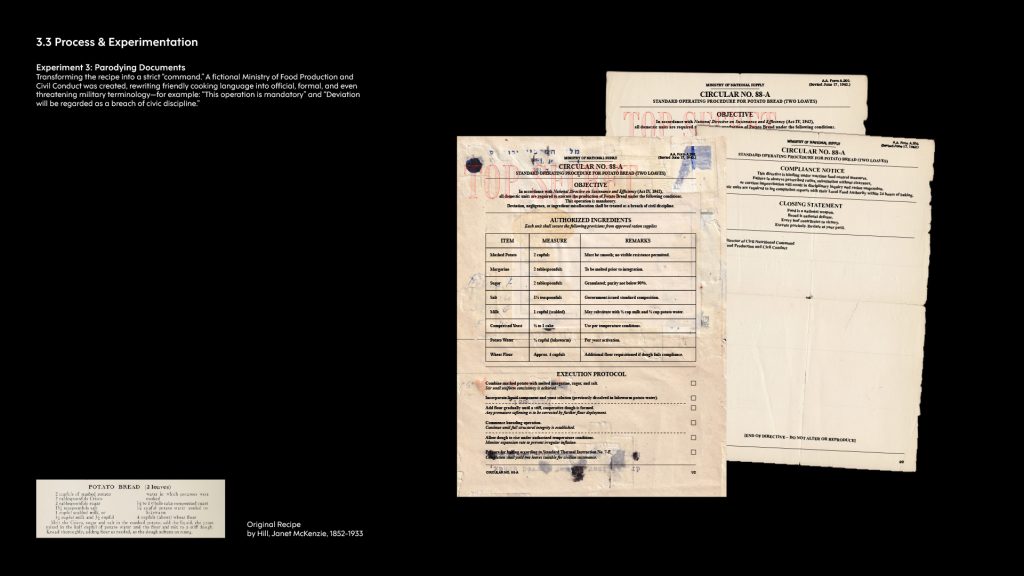
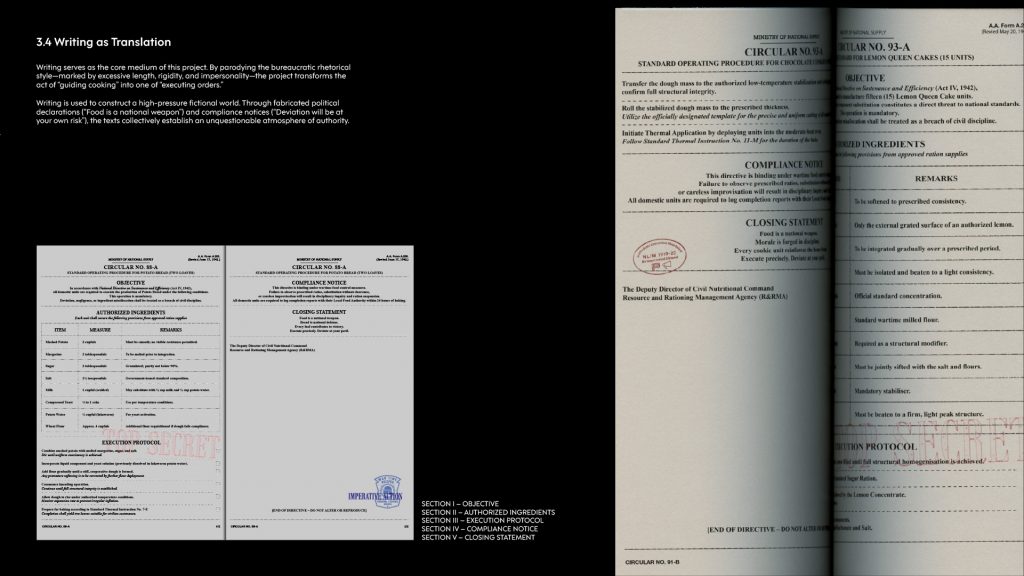
Writing serves as the core medium of this project. By parodying the bureaucratic rhetorical style—marked by excessive length, rigidity, and impersonality—the project transforms the act of “guiding cooking” into one of “executing orders.”
Writing is used to construct a high-pressure fictional world. Through fabricated political declarations (“Food is a national weapon”) and compliance notices (“Deviation will be at your own risk”), the texts collectively establish an unquestionable atmosphere of authority.
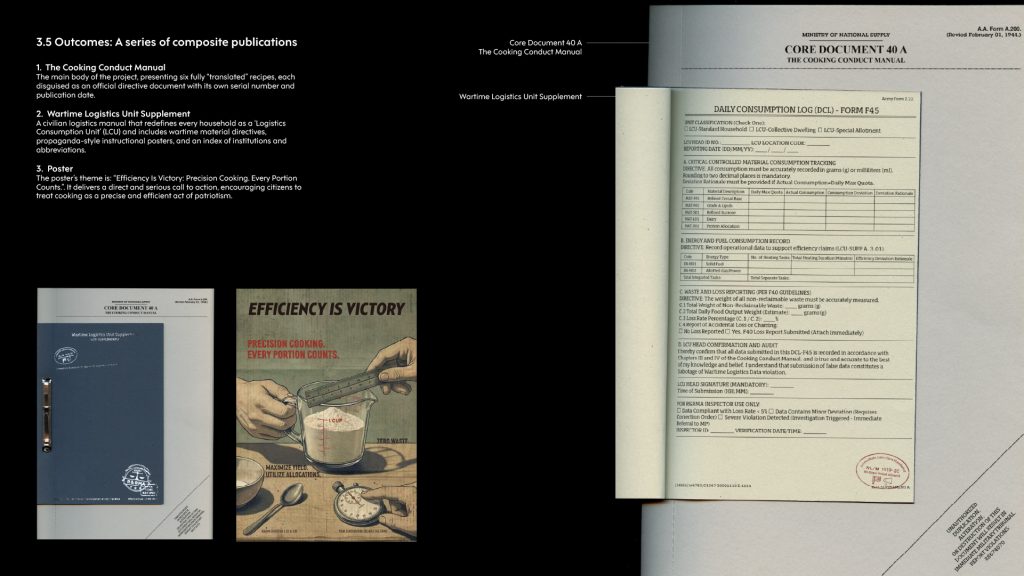
Final Outcome: A set of composite publications
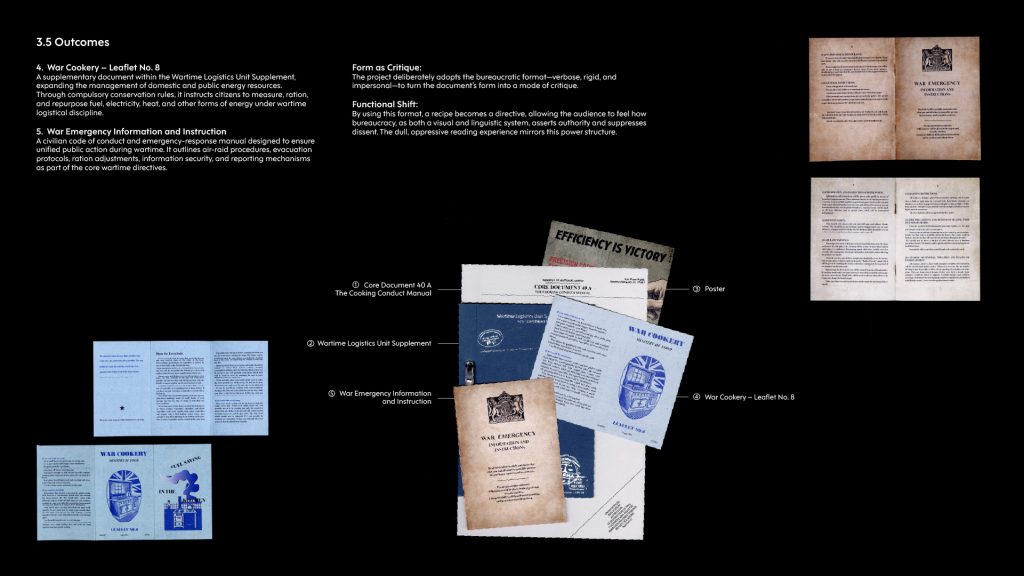
1 The Cooking Conduct Manual
The main body of the project, presenting six fully “translated” recipes, each disguised as an official directive document with its own serial number and publication date.
2 Wartime Logistics Unit Supplement
Serves as the primary guide, constructing a highly regulated wartime environment through propaganda posters, codes of conduct, abbreviation lists, and fictional government logos.
3 Poster Series
The theme of this poster is: “Efficiency Is Victory: Precision Cooking. Every Portion Counts.” It delivers a direct and serious call to action, encouraging citizens to view cooking as a precise and efficient patriotic duty. The visual language highlights meticulous measurement and controlled action, elevating cooking to a standardized wartime task, similar to work on an industrial production line.
4 Manual of Wartime Energy Conservation
This publication serves as a supplementary administrative document to the Wartime Logistics Unit Supplement. Its core theme is the militarization of energy consumption in both household and public settings through mandatory conservation measures. It provides detailed instructions on how citizens should precisely measure, optimize, and reclaim various forms of energy—such as fuel, electricity, and heat.
5. 战争紧急情况信息和指示
This is a wartime citizen conduct manual and emergency response handbook, whose core purpose is to ensure individuals can respond efficiently and uniformly to government directives and unforeseen circumstances during wartime. Written in clear and authoritative language, the handbook details specific actions and reporting obligations for various emergency situations, emphasizing that individual compliance with regulations is crucial to national collective security.
The adoption of bureaucratic publishing formats is deliberate. By appropriating the form of government documents—with their verbosity, rigidity, and impersonal nature—the project transforms the format itself into a critical tool. The bureaucratic format facilitates the conversion from formula → directive. It forces the audience to experience how the bureaucratic system has historically functioned as a visual and linguistic tool to establish authority and suppress dissent. The sense of dullness or oppression felt during reading precisely mirrors the essence of this power structure.
The project began with a practical inquiry—“How can a recipe be translated in different ways?”—but ultimately evolved into a deeper critical question: “How does the visual language of bureaucracy operate as a tool of power?”
Translation is not merely a change of form; it is an act of power reconstruction. Design can serve as a powerful critical tool to reveal the often-overlooked dynamics of authority embedded in everyday life.
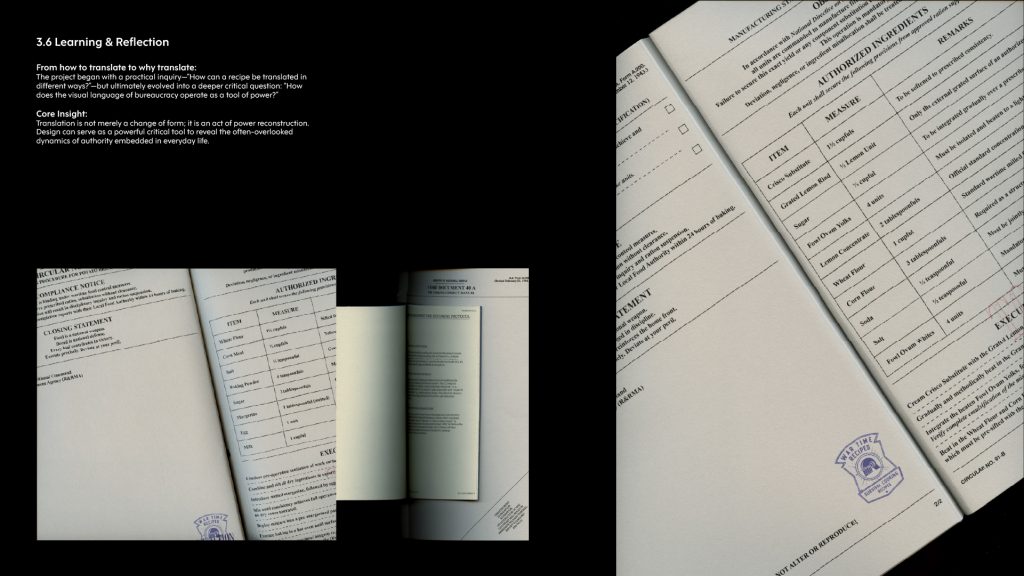
To be honest, upon completing the project, I didn’t feel a conventional sense of “creative achievement”; in fact, I found the final presentation somewhat dull. However, I realized that this “dullness” is exactly the point—it is the inherent, soul-crushing style of genuine government bureaucracy.