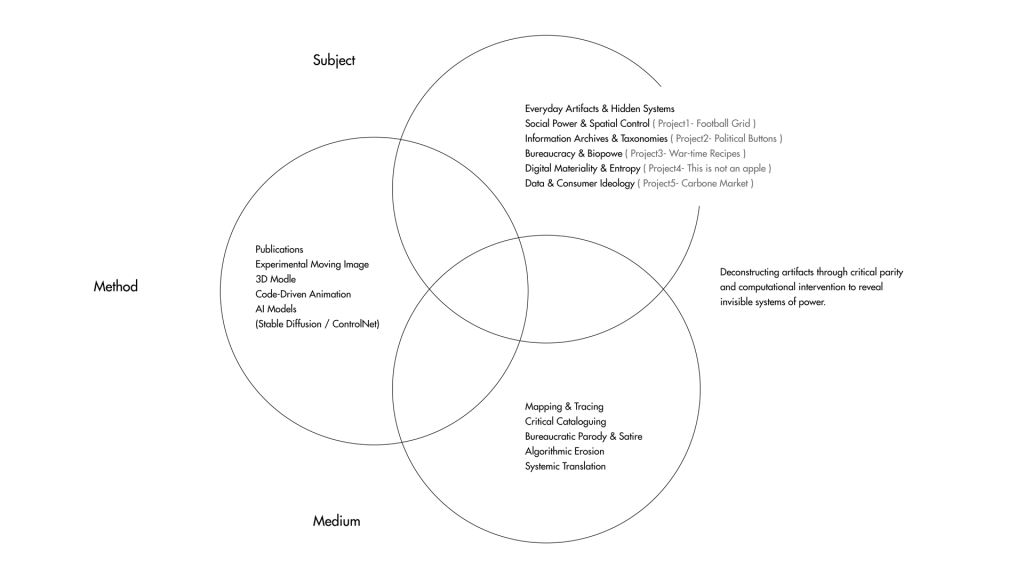
Before starting this project, I kicked things off by creating a Venn diagram to organize and reflect on my Unit 1 work. My goal was to pinpoint the specific topics and experimental tools that really sparked my interest.
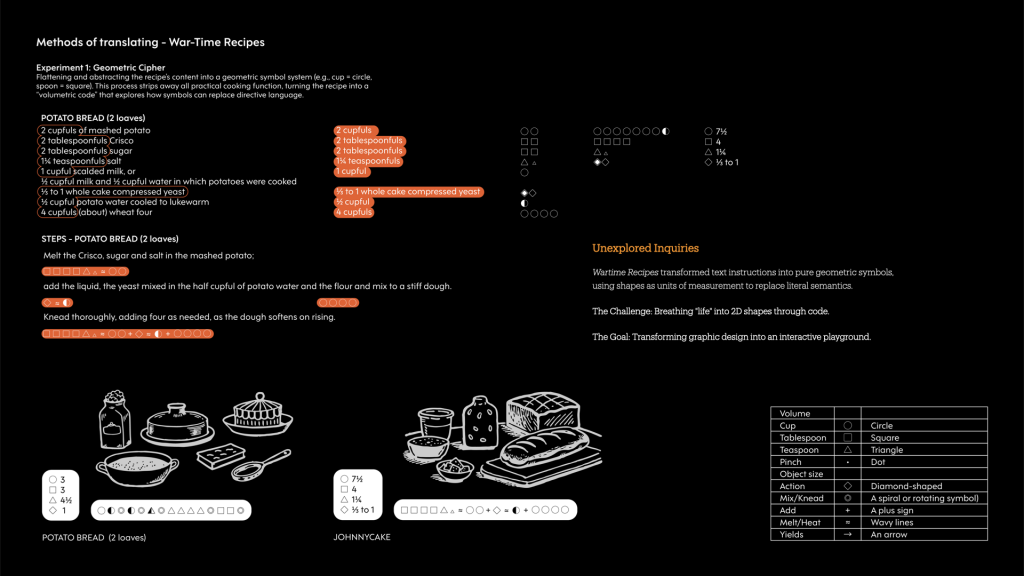
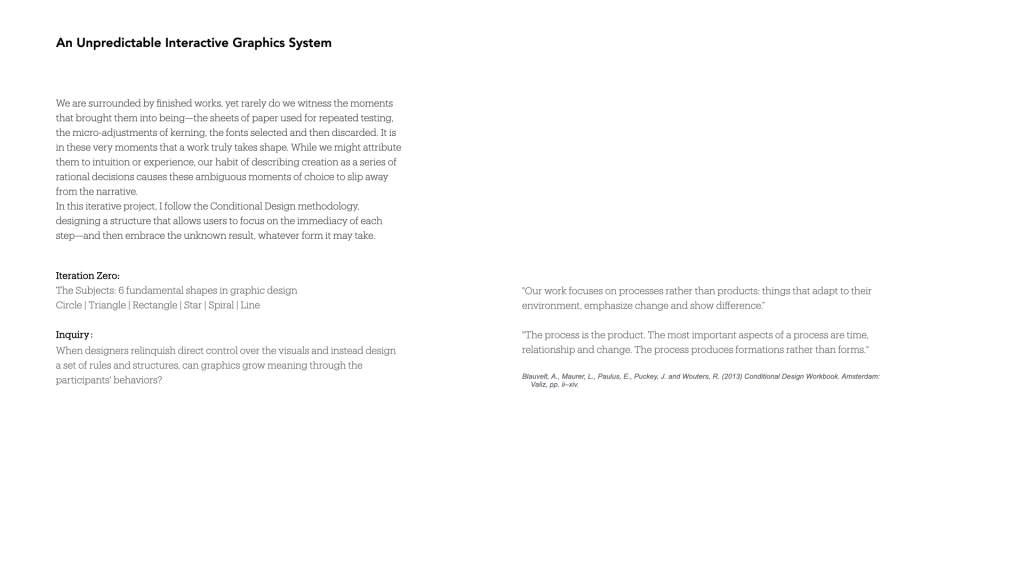
In my previous unit’s project, Wartime Recipes, I transformed text instructions into pure Geometric Ciphers, stripping away their original meanings. It got me thinking: could these abstract shapes be brought to “life” through code? What if graphic design wasn’t just about fixed coordinates in layout software, but an interactive playground where the relationships between shapes could trigger a visual chemical reaction?
At the same time, during the Apple Decay experiments in Unit 1, I used Python scripts within Blender keyframes to deconstruct models. While I’m eager to master code, the steep learning curve of traditional programming often slows down rapid visual iteration. This term, I want to dive into Vibe Coding—using natural language and AI to co-create interactive web applications.
These two projects led me to the same core question: If a designer relinquishes direct control over the canvas and instead designs a set of rules and structures, can graphics develop their own meaning through the participant’s actions?
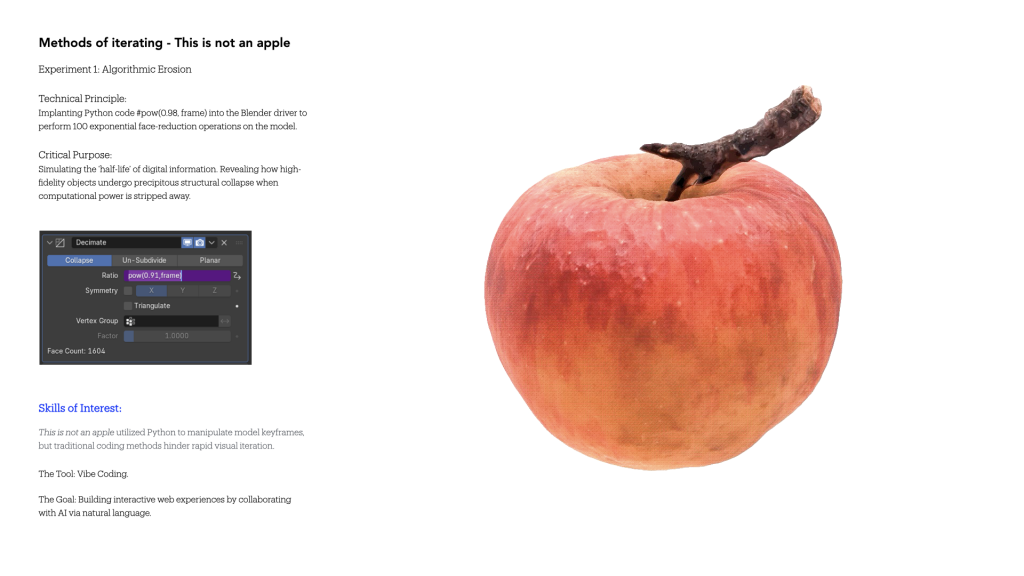
Driven by this inquiry, I spent this week exploring the intersection of graphics and Vibe Coding. I built a website that transforms a maze into a graphic generator, using six primitive geometric shapes as Iteration Zero—the starting point of the evolutionary process.
As players navigate a 10×10 maze using arrow keys, the graphics on the right side of the screen deform, split, and rotate in response to their movement. Once a player reaches the exit, the unique graphic generated by that specific path is automatically saved.
A maze naturally creates and constrains choices: every fork in the road forces a decision, yet the walls forbid any shortcuts. In this system, every step taken is translated into a parametric shift in the graphic. My role has shifted from “the one who composes” to “the one who defines the translation rules.” Similarly, the player is not “designing” in the traditional sense; they are making instinctive pathfinding choices within a constrained structure.
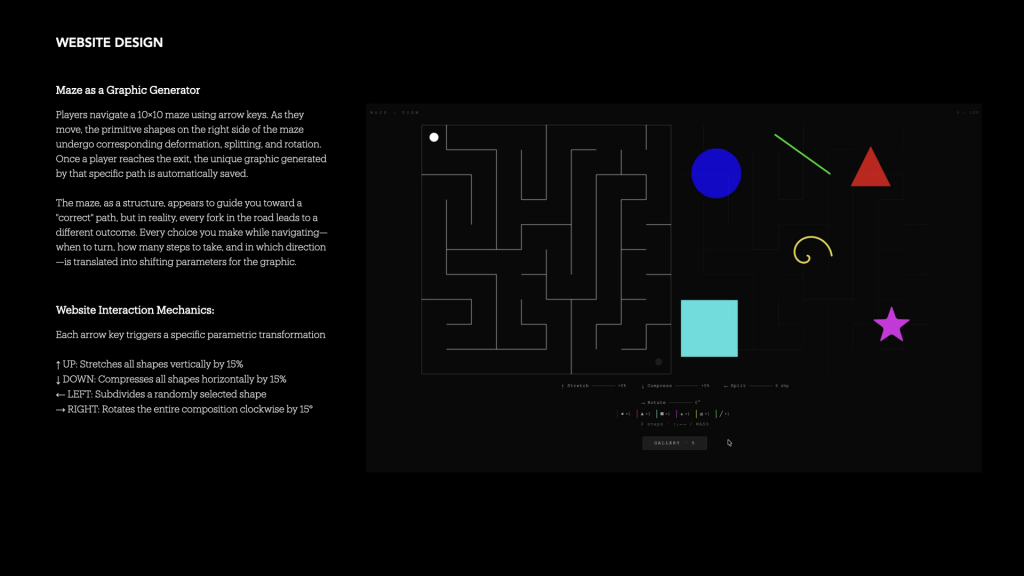
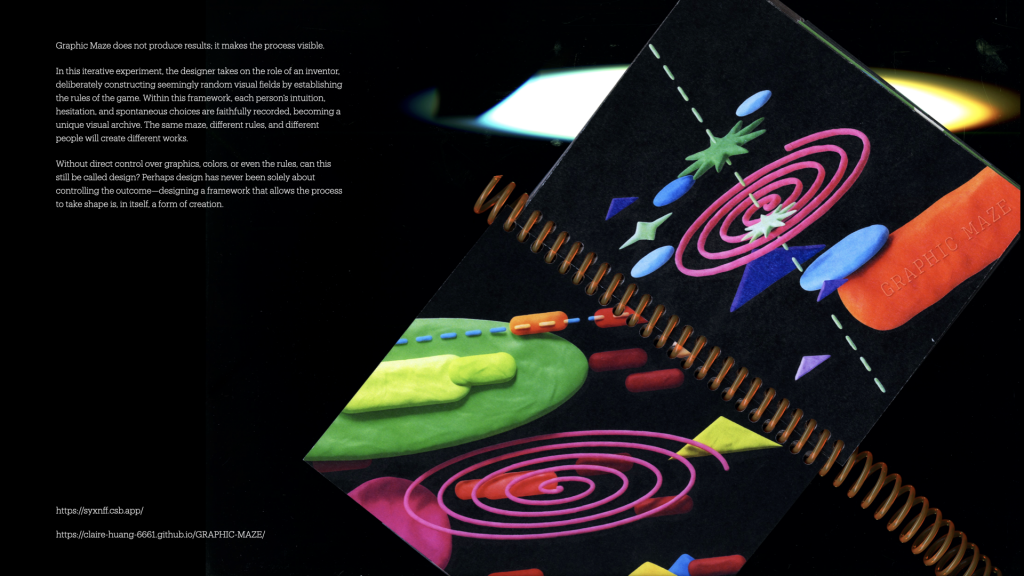
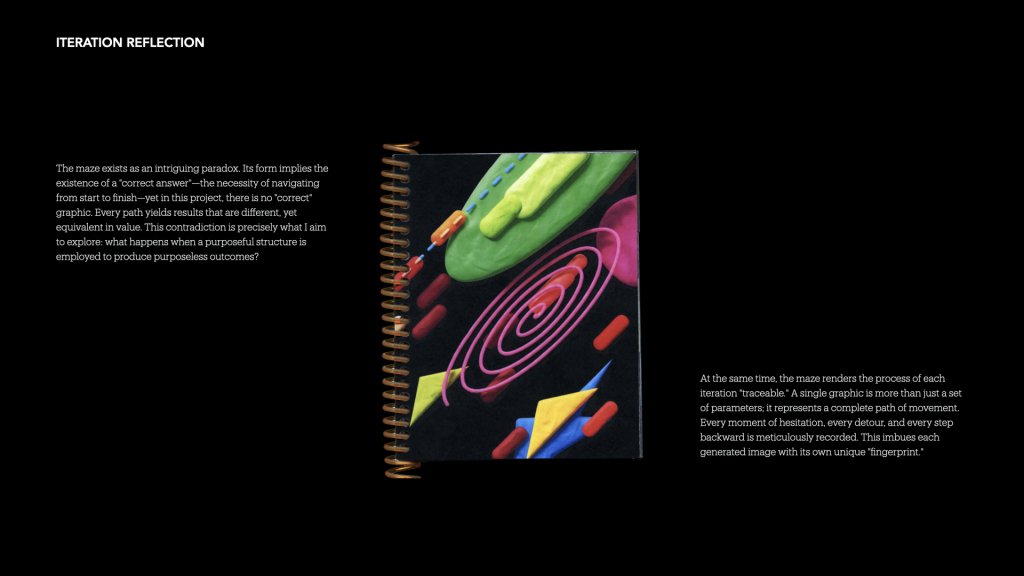
This publication, Graphic Maze, serves as a complete experimental log of 100 iterations I ran through the generator. Every page represents a single experiment.
The top half displays the experimental data, showing the maze path and specific parameters. These numbers are essentially the “recipe” for the image. The bottom half shows the result—the graphic generated by that maze path. Six primitive shapes (circle, triangle, rectangle, star, spiral, and line) are stretched, compressed, split, and rotated as I “walked,” eventually layering into a final composition.
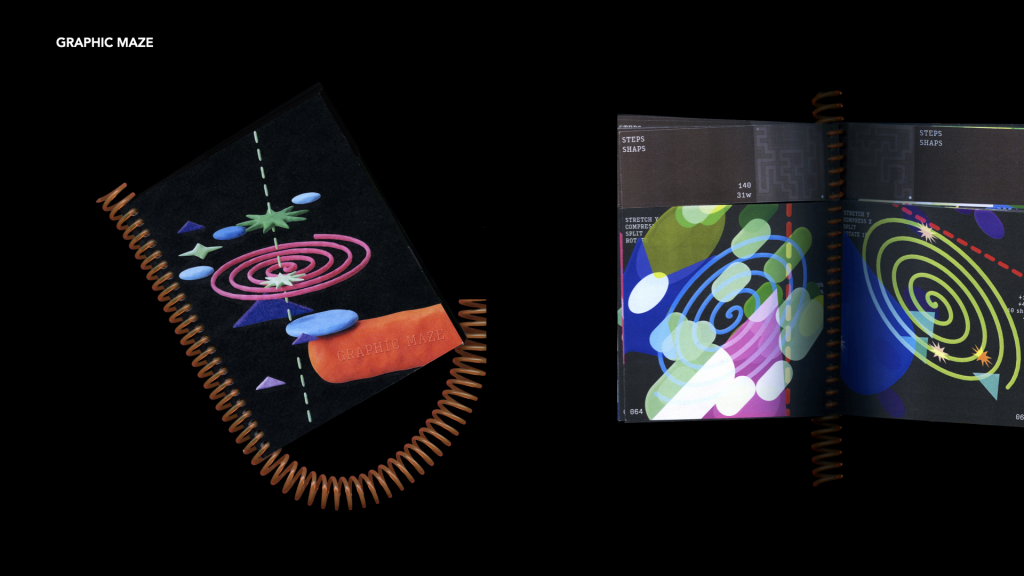
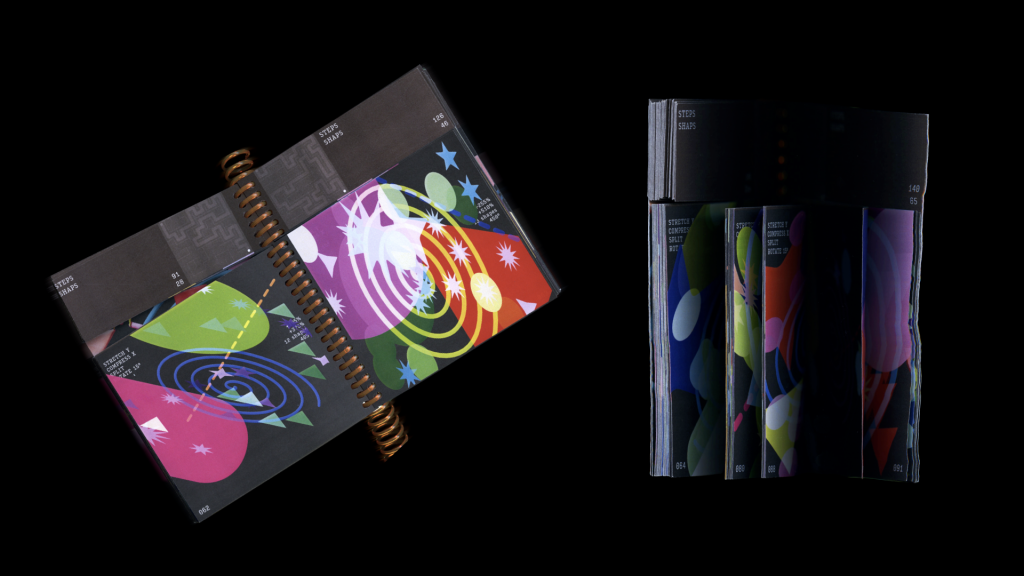
There’s no single way to read this book. You can watch the 100 iterations evolve from start to finish, or just flip to a random page and treat it as a stand-alone piece. You can also compare the data across pages—images with more steps are usually denser and more complex, but not always. The direction of the moves matters more than the number of steps. Two 30-step runs could look completely different if one involved mostly left turns (heavy splitting) while the other was mostly right turns (heavy rotation)
The maze is an interesting paradox. Its form suggests there is a “correct answer” (getting from start to finish), but in this project, there is no right or wrong graphic—every path produces a result that is different yet equivalent. This contradiction is exactly what I wanted to express: what happens when you use a purposeful structure to produce a purposeless outcome?
Finally, the maze makes every iteration traceable. An image is more than just a set of parameters; it’s a full path—recording every hesitation, detour, and backtrack. This gives every single graphic its own unique “fingerprint”.
During first week’s group discussion, we discovered that while the generated graphics vary randomly along with the maze paths, the visual style exhibits a certain degree of similarity because the six basic elements are predetermined.
So this week, I continued to optimize the design of this graphic generation webpage, allowing users to participate in setting the game rules within the “maze” framework.
In Week 2, the maze was upgraded from a fixed-rule pattern generator to a user-customizable creative framework. Before entering the maze, users can customize the patterns to be displayed and their initial colors, and the system supports the input of text. Additionally, players can customize the pattern changes triggered by directional keys, the textures of the patterns, and the visual effects created by layering them.
Each step taken within the maze is translated into a parameter change for the graphic. The designer’s role shifts from “composer” to “rule-maker,” while players have little control over the outcome as they navigate the maze; they simply make instinctive path choices within a constrained structure.
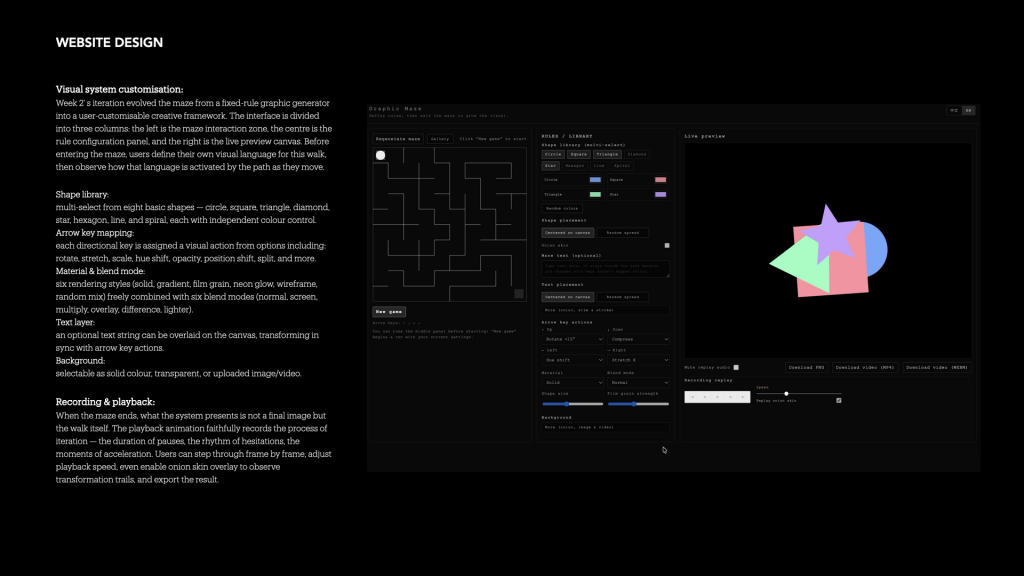
In the new design, the up, down, left, and right arrow keys have been assigned distinct sounds, making the player’s movement through the maze—as well as the rhythm of their pauses—more pronounced.
Most importantly, at the end of the game, the system does not display a final image, but rather the journey itself: all the pauses, moments of confusion, and turns back are preserved in the rhythm and texture of the animation. Images and videos of the process can be exported in their entirety.
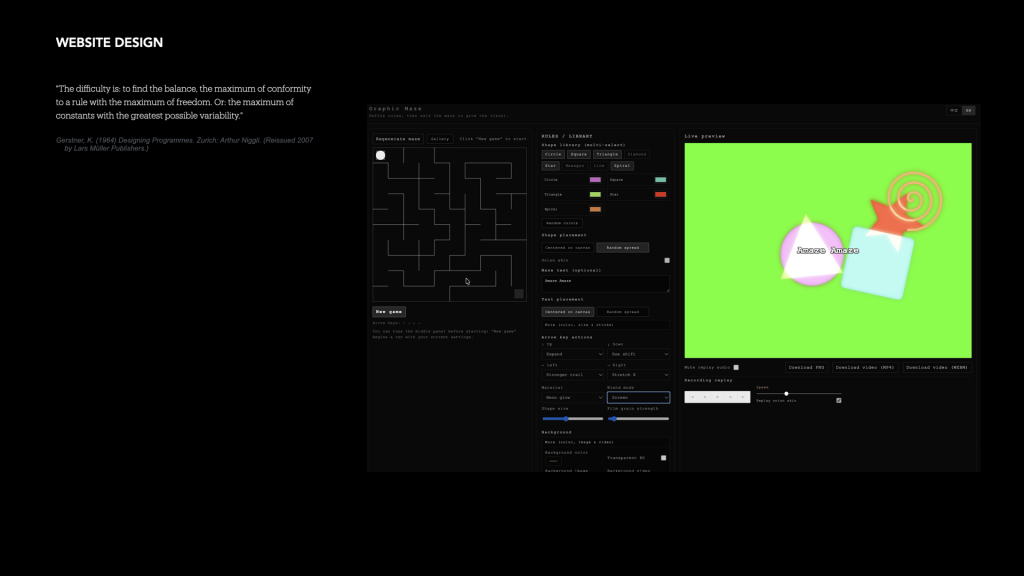
In Graphic Maze, the framework (the maze structure and game rules) is constant, while the creative content is variable. The entire iterative system is neutral, faithfully rendering the process visible. Throughout this process, the player transitions from a walker to a rule-maker to a viewer of the animated result, with each layer generating new meaning.
In addition to designing the website, I also created a video. The video aims to showcase the player’s inner thoughts as they navigate the maze in a lighthearted way.
The rhythmic sounds in this video weren’t added intentionally; they were generated naturally as the player moved through the game using the arrow keys.
Graphic Maze does not produce results; it makes the process visible.
In this iterative experiment, the designer takes on the role of an inventor, deliberately constructing seemingly random visual fields by establishing the rules of the game. Within this framework, each person’s intuition, hesitation, and spontaneous choices are faithfully recorded, becoming a unique visual archive. The same maze, different rules, and different people will create different works.
Without direct control over graphics, colors, or even the rules, can this still be called design? Perhaps design has never been solely about controlling the outcome—designing a framework that allows the process to take shape is, in itself, a form of creation.