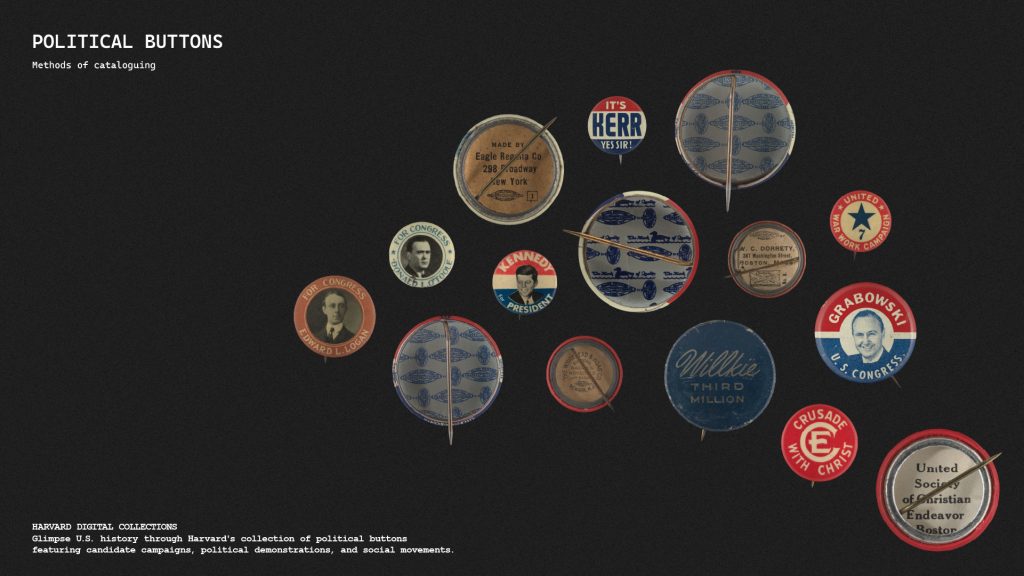
In American history, colour has played a complex and ever-shifting role in presidential campaigns. It is not merely decoration, but a coded language of identity, emotion, and geopolitics.
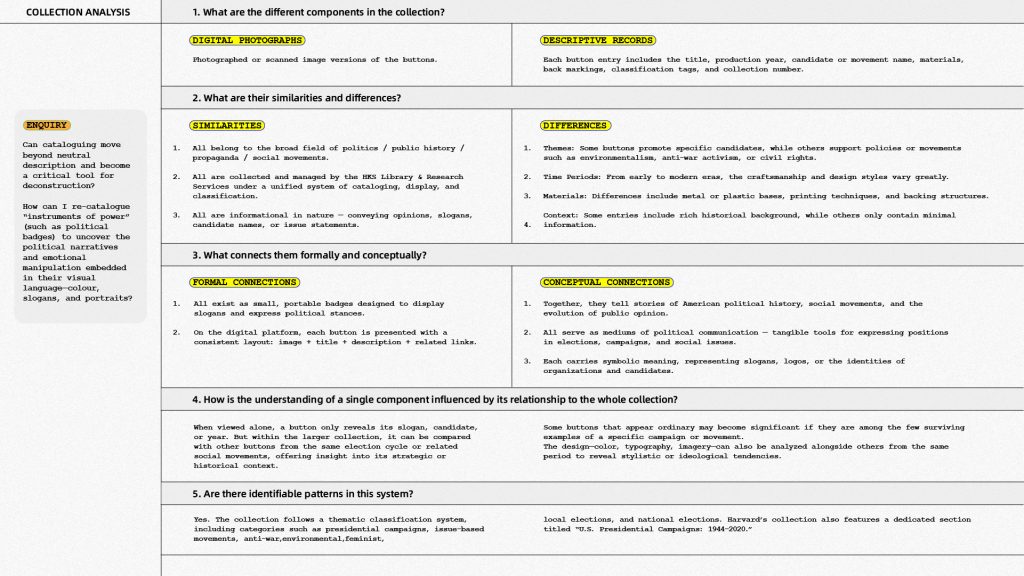
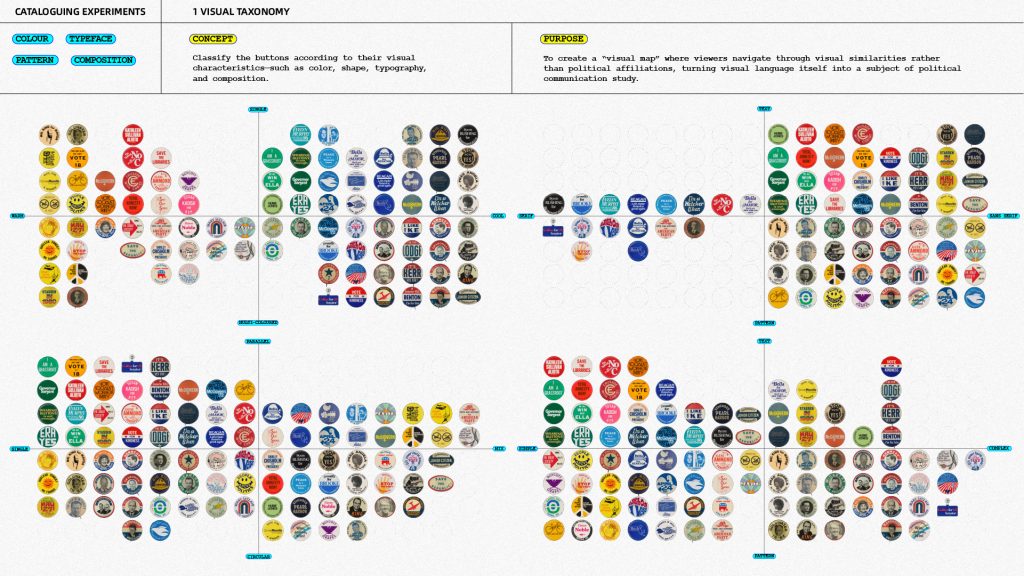
I experimented with 3 different cataloguing methods. The first one is Visual Taxonomy.
I classified the buttons based on their visual features—such as color, pattern, typography, and composition. The aim is to organize them by visual similarities rather than political positions, allowing the visual language itself to become the subject of study in political communication.
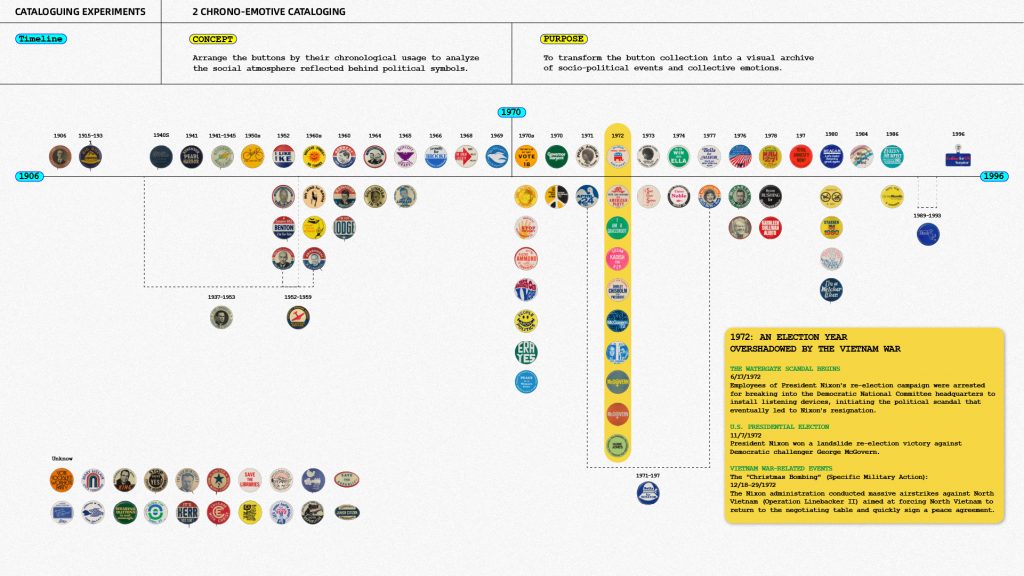
Then I tried the second cataloguing method — reordering the buttons by time.
I noticed that 1972 had the largest number of buttons, so I looked into major U.S. political events that year. It was a presidential election year heavily shaped by the Vietnam War, and the following key events took place:
- The Watergate scandal
- The U.S. presidential election
- Vietnam War–related events — the United States carried out the “Christmas Bombing” against Vietnam
From the dates and quantities of the buttons, we can also observe the social climate and public attitudes of that historical period.
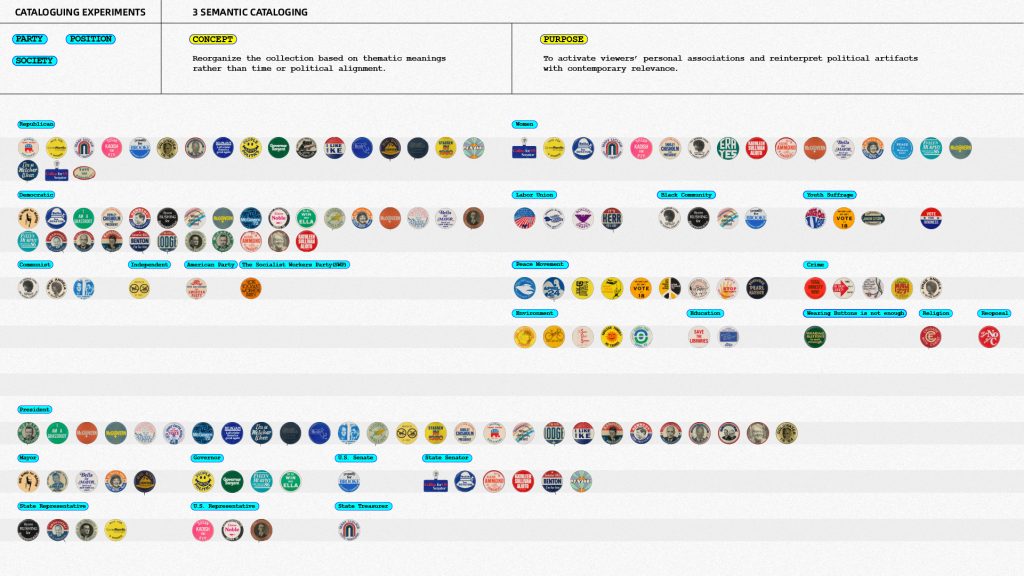
Here, I categorize based on the badge themes.
The badges in the upper-left corner are categorized by different political parties in the United States, revealing the prominent status of the Democratic and Republican parties in the country.
The badges in the upper right corner represent different voices in society. The first row features badges from female candidates. The second row showcases the power of workers, the Black community, and young people.
Many other badges focus on themes like peace, environmental protection, crime prevention, and education.
Interestingly, I also noticed people questioning the very existence of badges. For example, this green badge reads: “Wearing buttons is not enough.”
The badges below are all related to elections. Most are for presidential campaigns, though there are also badges for mayoral and gubernatorial races, as well as for candidates running for the Senate and House of Representatives.
From this, I discovered that badges represent the voices of diverse groups across America. As eye-catching, portable objects, they have become integrated into broad spheres of American society, history, politics, and economics.
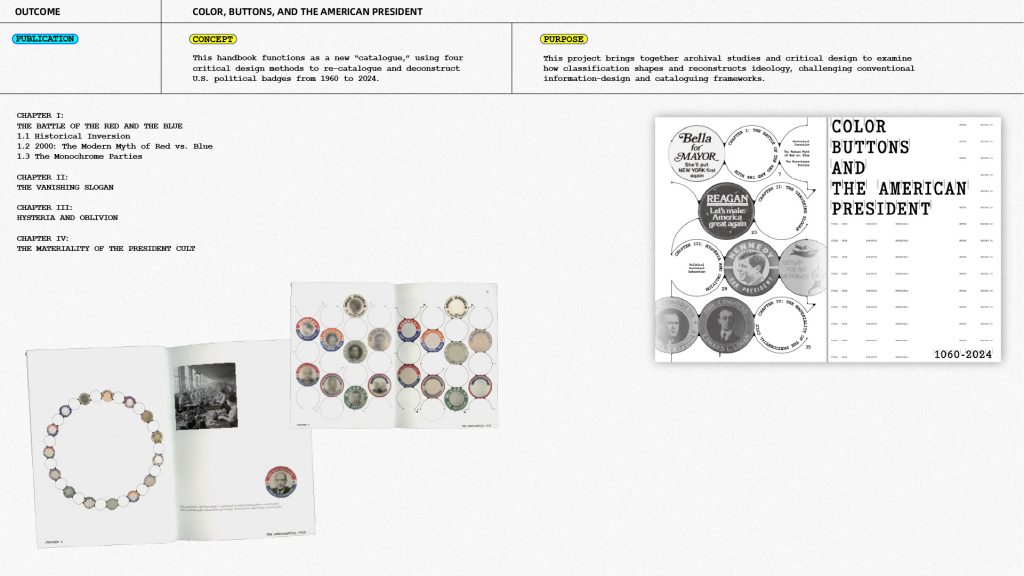
During the second week of the course, I further analyzed the colors, slogans, contexts, and portraits featured on political badges, attempting to engage in critical thinking about these visual elements. Based on these reflections and visual experiments, I created a small book.
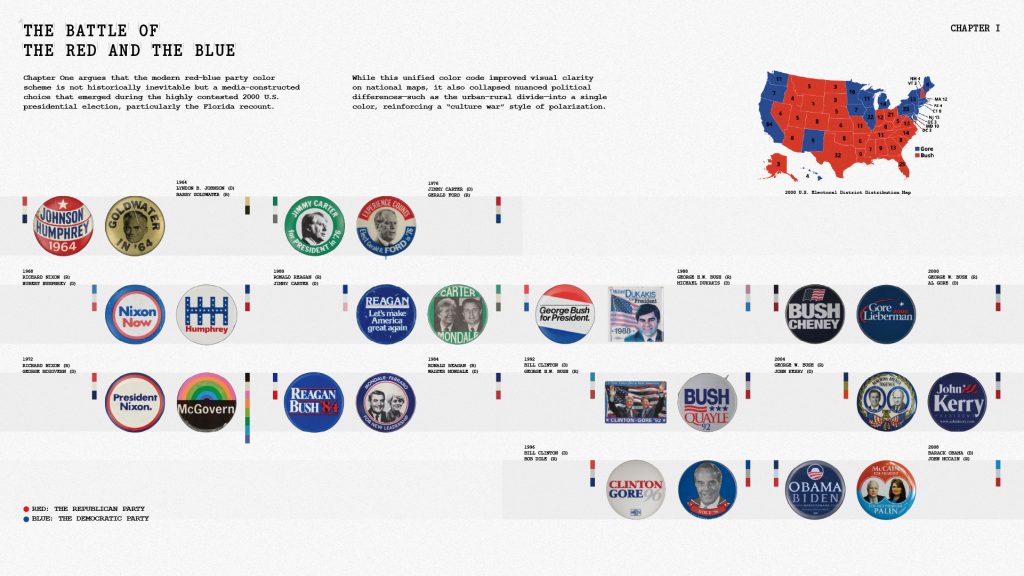
The first one, titled “Historical Inversion,” looks back at how, in the mid-20th century and earlier, the color allocation of major American parties often shifted.
Here, I collected U.S. political buttons from before the year 2000 and marked the main colors of each button with colored blocks. It’s clear that early button designs mostly used the red, blue, and white of the American flag as their dominant palette. There were also cases of personalized color choices — for instance, Jimmy Carter used green as his signature campaign color in both of his presidential runs. There were even times when Red represented the Democrats and Blue the Republicans. It’s interesting to note that Reagan, a Republican, almost exclusively used blue in his campaign buttons — even though red is now the defining color of the Republican Party.
The modern color assignment is not historically inevitable, but rather a choice shaped by media representation. During the 2000 U.S. presidential election, the vote-counting process was prolonged and highly controversial — especially the recount in Florida. To display state-by-state results more clearly and consistently on national maps, major news networks such as NBC, CBS decided to adopt a unified color system: red for the Republican Party and blue for the Democratic Party.
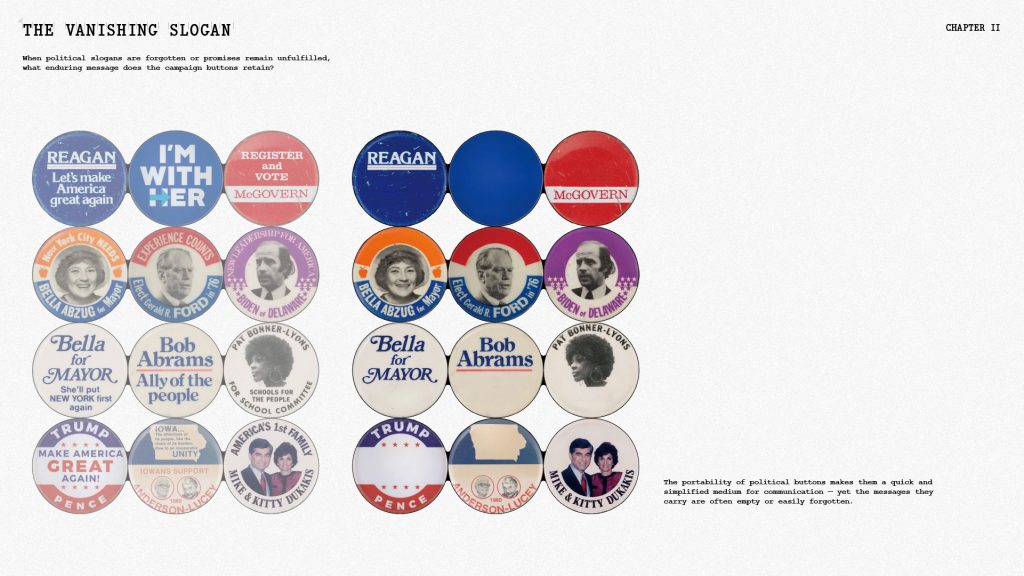
The second chapter is the vanishing slogan. When political slogans are forgotten, or promises remain unfulfilled, what enduring message do the campaign buttons retain?
The portability of political buttons makes them a quick and simplified medium for communication — yet the messages they carry are often empty or easily forgotten.
In this chapter, I attempted to erase the campaign slogans printed on these buttons. By removing these surface-level messages, I aim to challenge their political credibility. For instance, once the slogan is gone, Hillary Clinton’s button is reduced to nothing but the blue symbol of her party.
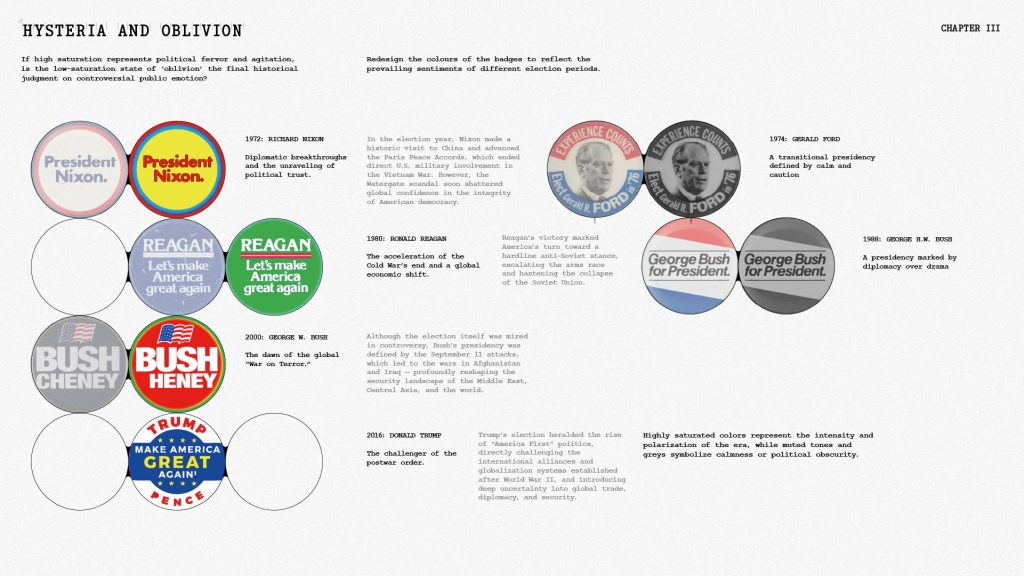
In the third chapter, I shift the focus from language to emotion.
In this chapter, I selected presidents who were either highly controversial or relatively low-profile in history. I then adjusted the color saturation of the buttons according to the level of “controversy” or “hysteria” during their terms.
Highly saturated colors represent the intensity and polarization of the era, while muted tones and greys symbolize calmness or political obscurity. Through this visual method, I attempt to quantify the emotional strength of political propaganda and reveal how color functions as an amplifier of collective sentiment.
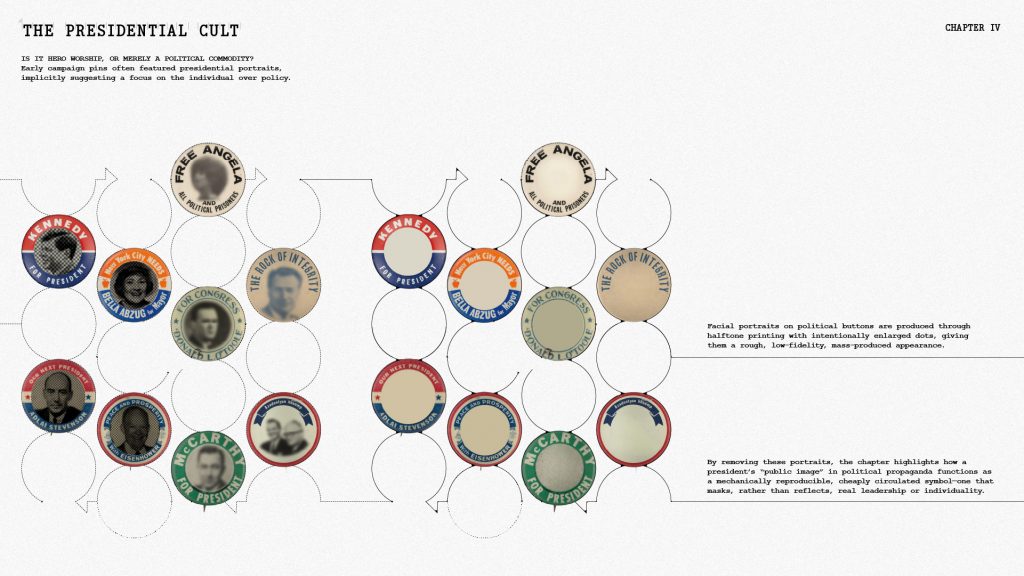
In this final chapter, I experimented with redesigning campaign buttons by deconstructing presidential portraits through a process of materialization. Historically, these buttons prioritized the candidate’s visage over policy, fostering a cult of personality.
My process began with obscuring the portraits, leaving only the names as anchors of identity. I then re-interpreted these faces using exaggerated halftone screens. By amplifying the dot gain, the images appear coarse and low-fidelity—emphasizing their nature as mass-produced commodities. This treatment reveals how a leader’s “public image” is reduced to a mechanically reproducible symbol within political propaganda, stripped of genuine individuality and leadership.
This project seeks to deconstruct the established meaning of buttons as instruments of power transmission, critically cataloguing and creating political buttons from the United States spanning 1960 to 2024. Through examining their colours, slogans, contexts, and portraits, it challenges the functional purpose and historical context of buttons to explore the value of political insignia.